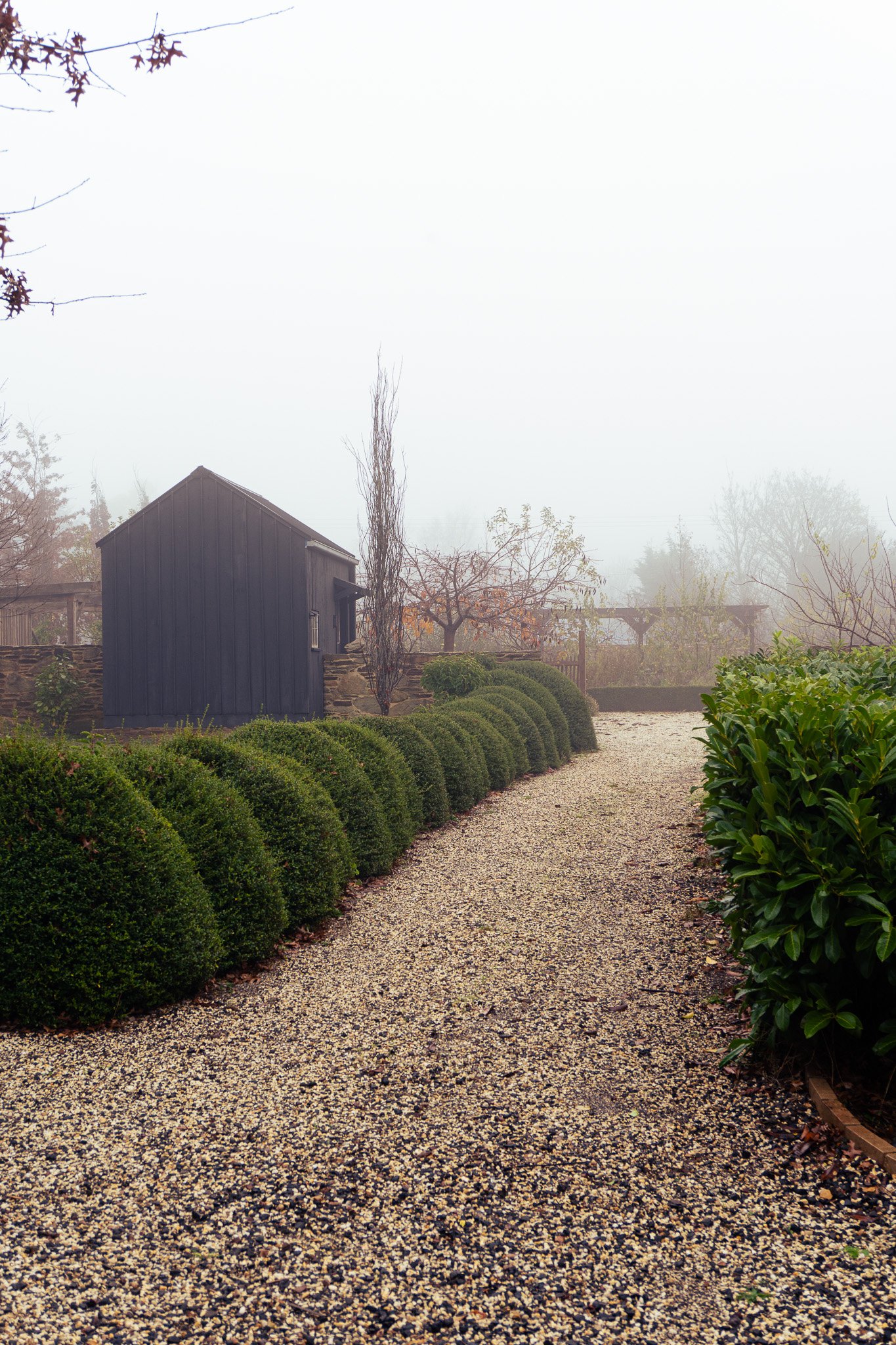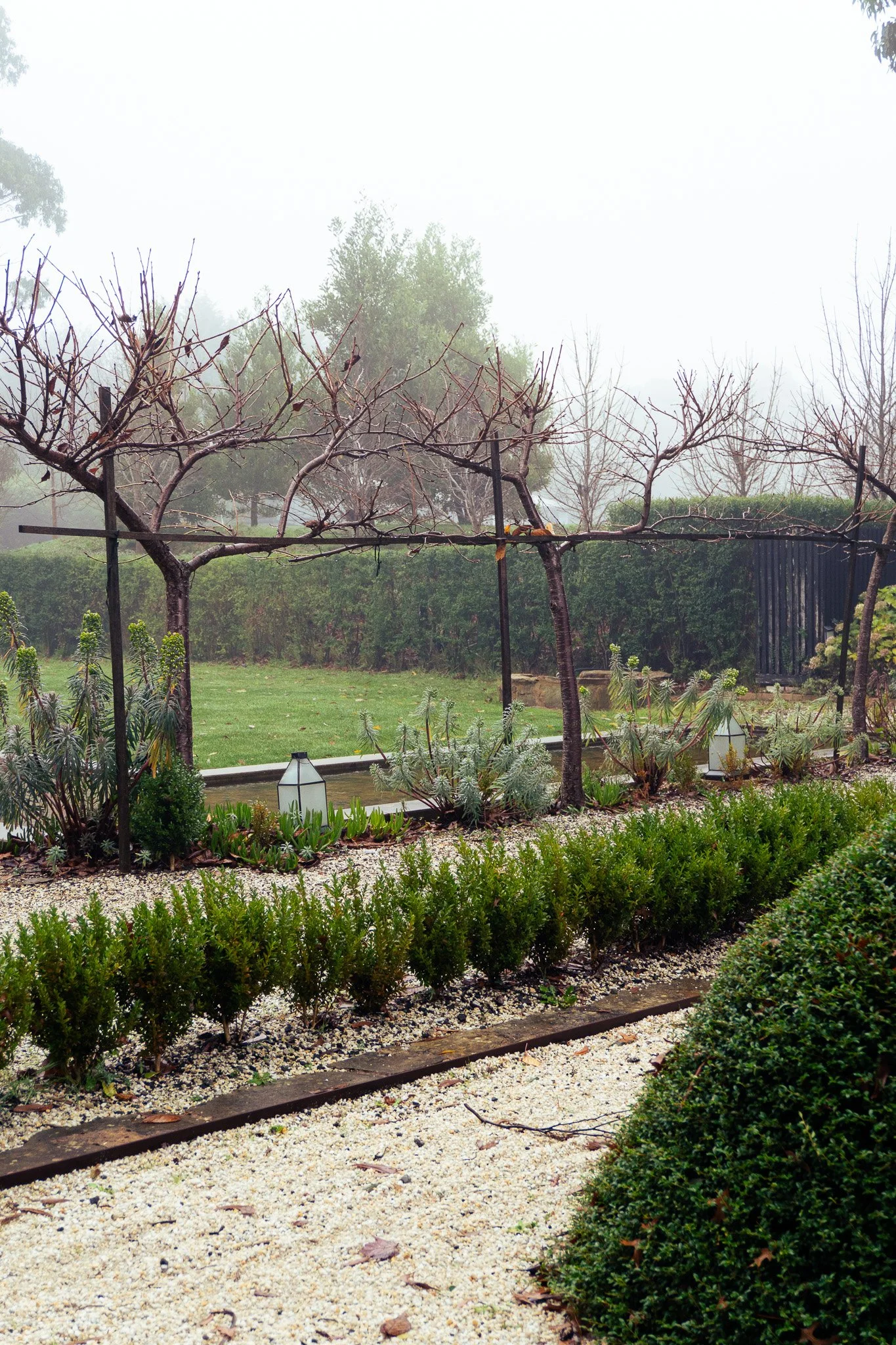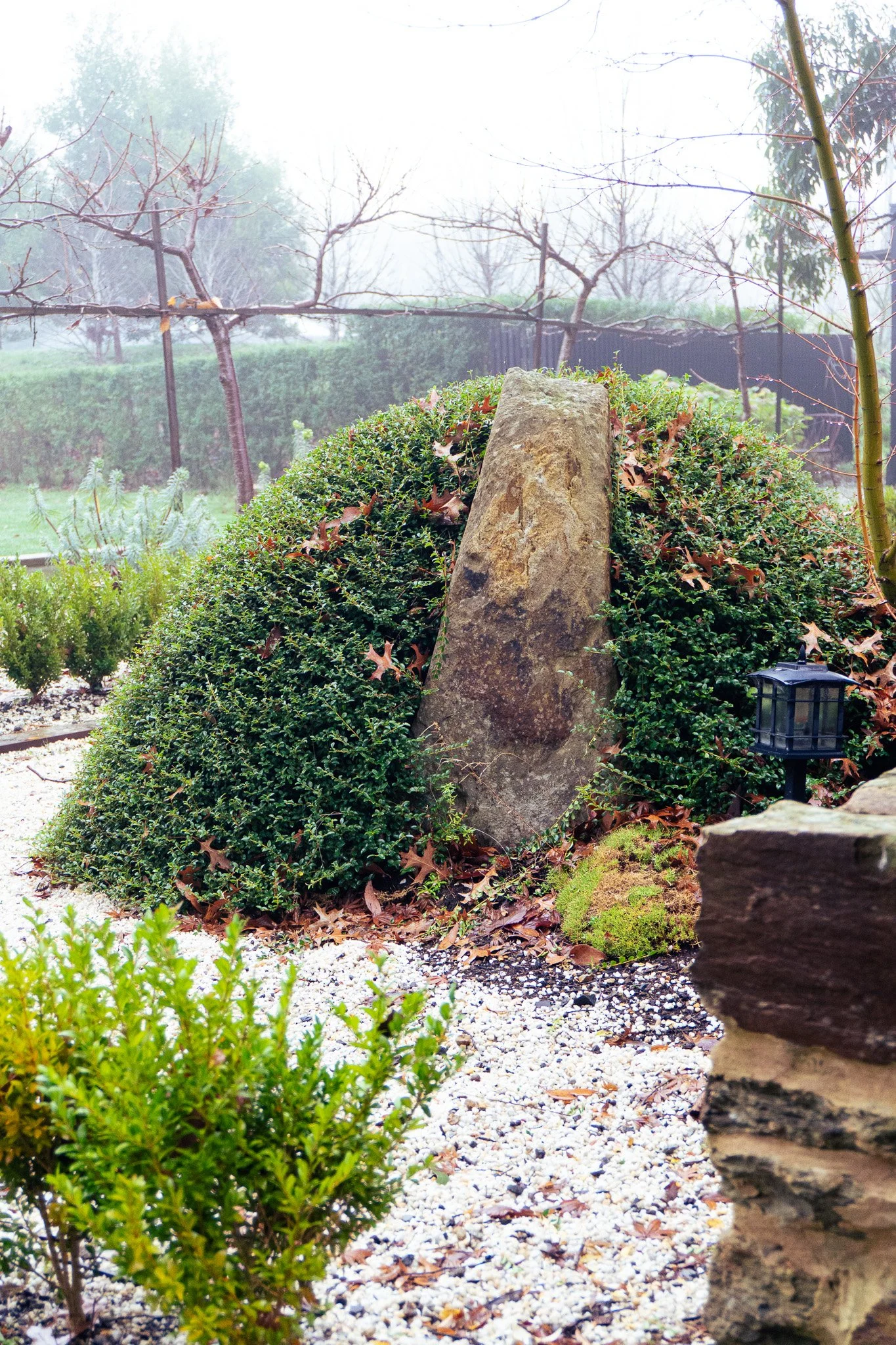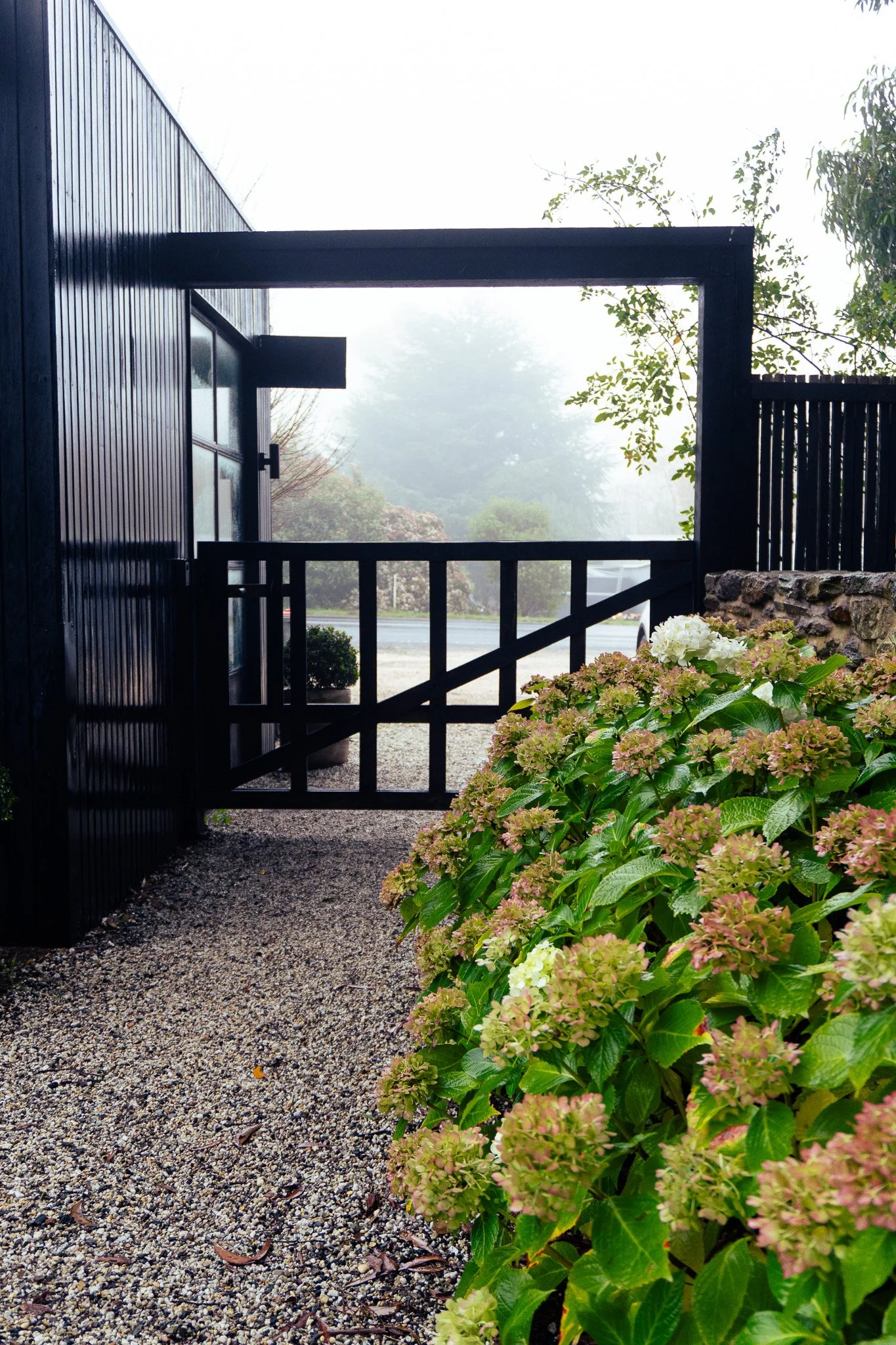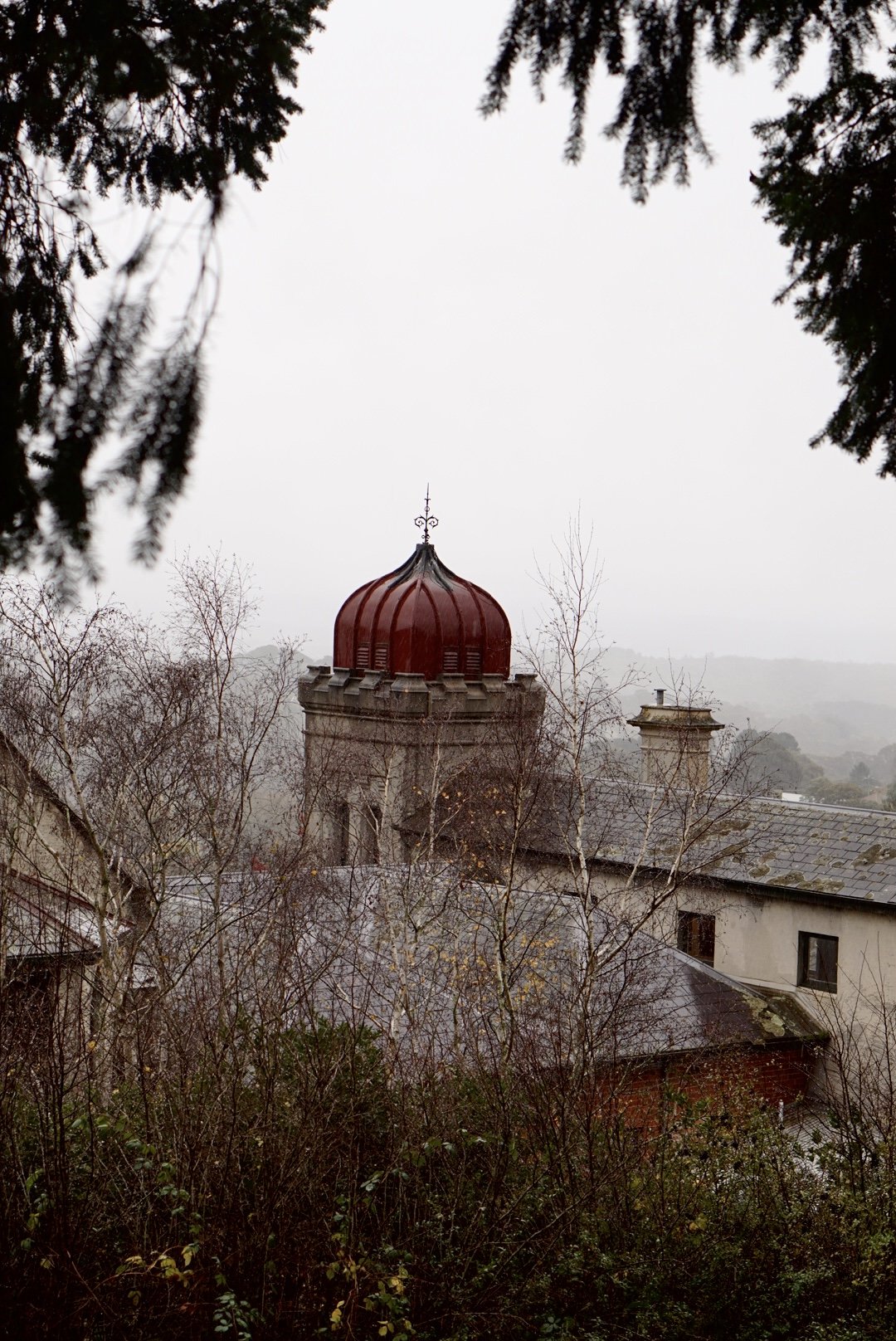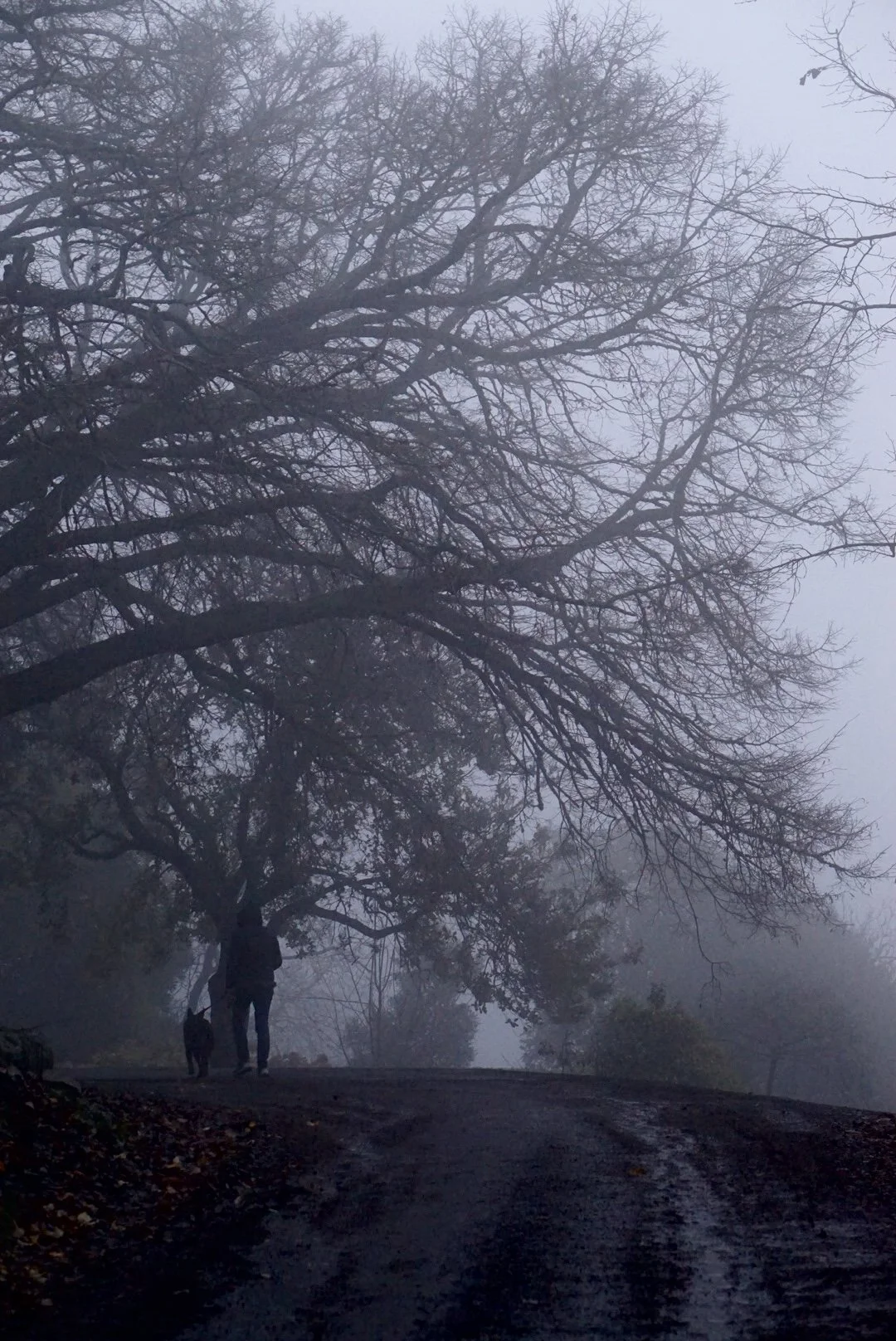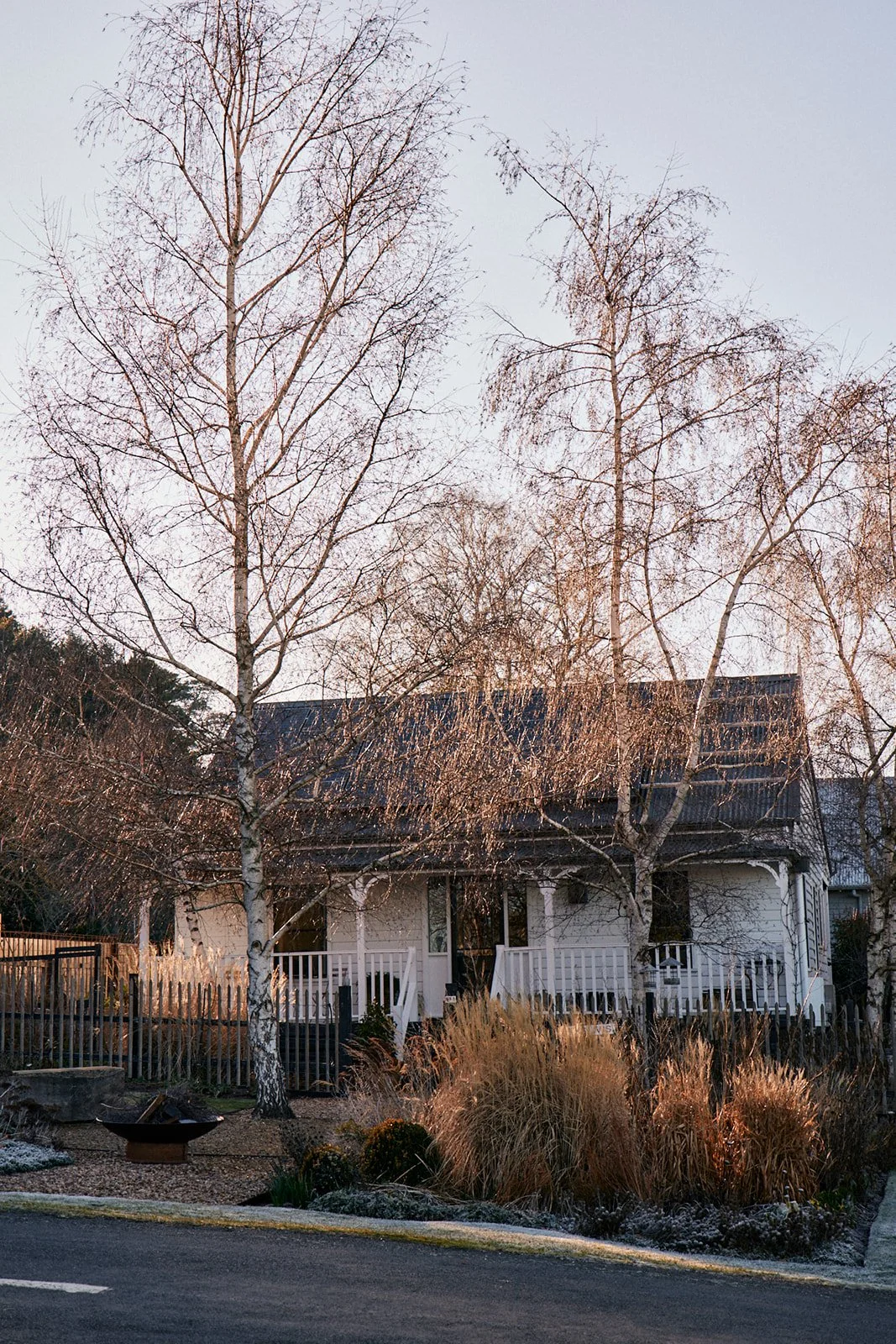

I spent an hour this week talking with Joel from InStyle Gardens for his podcast, and somewhere in the middle of it I heard myself once again sharing something that is at the core of what I do and believe: that I design through experience, and that the size of a garden has almost nothing to do with whether it's any good.
Read Morefruit trees
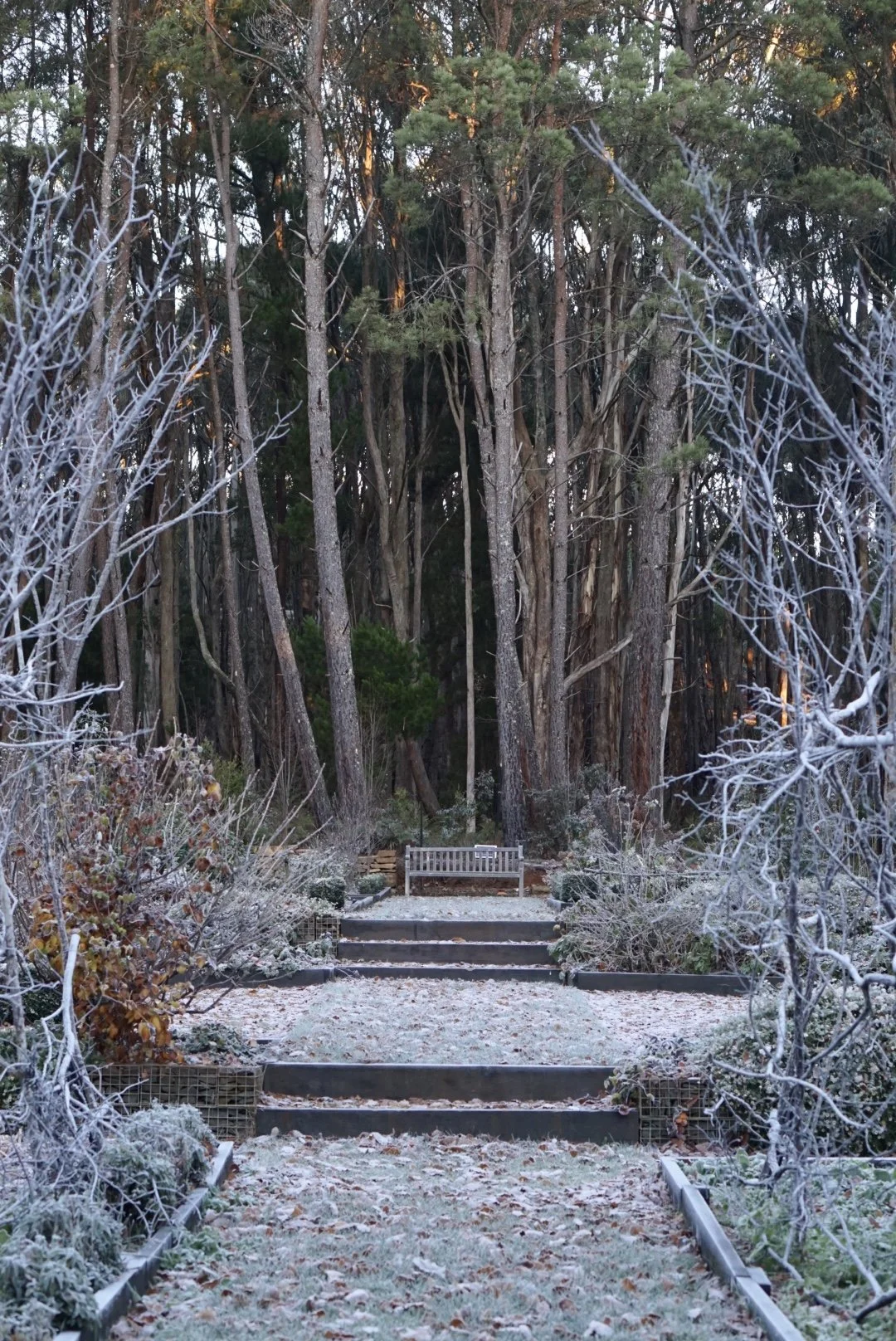
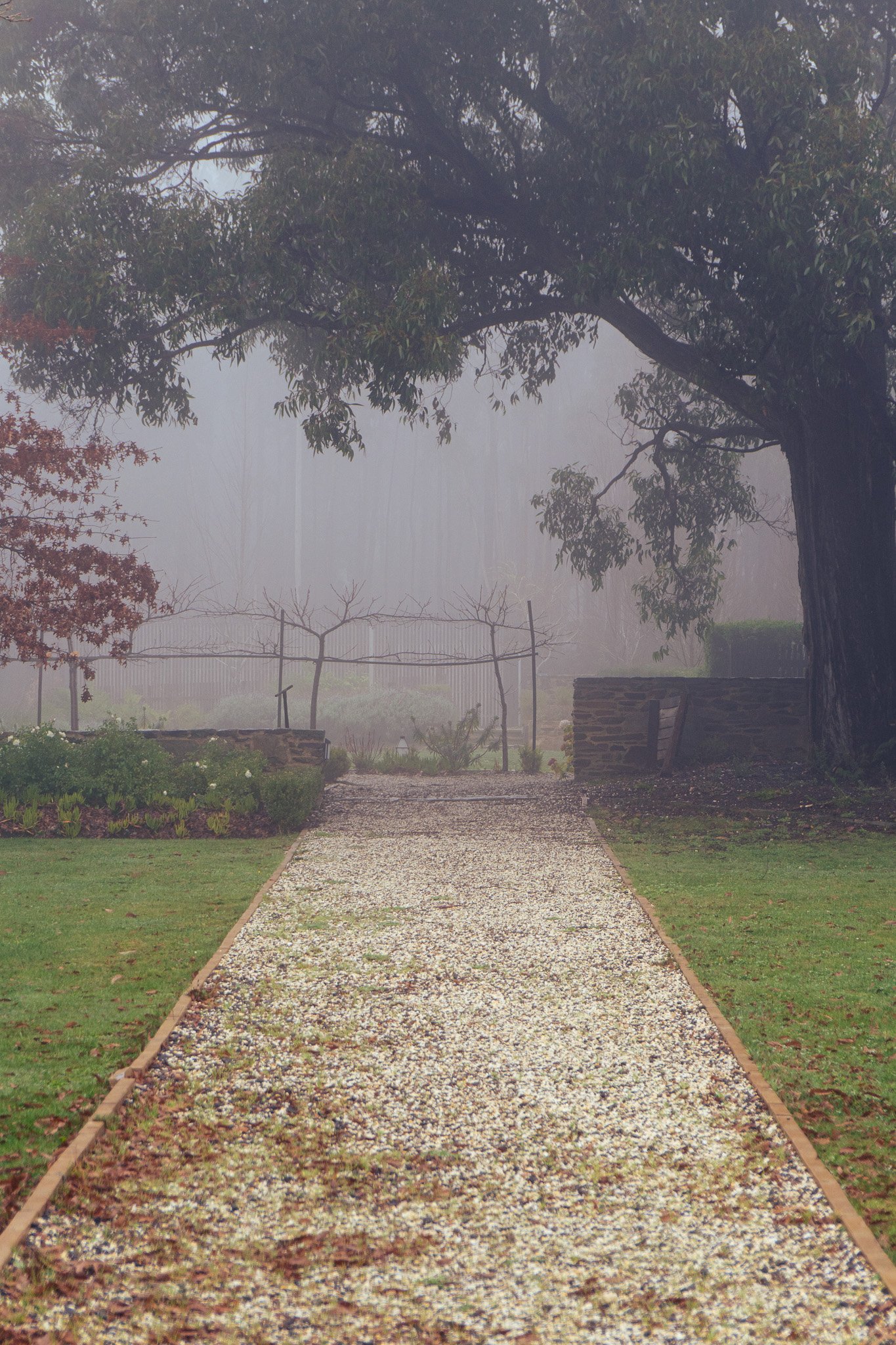
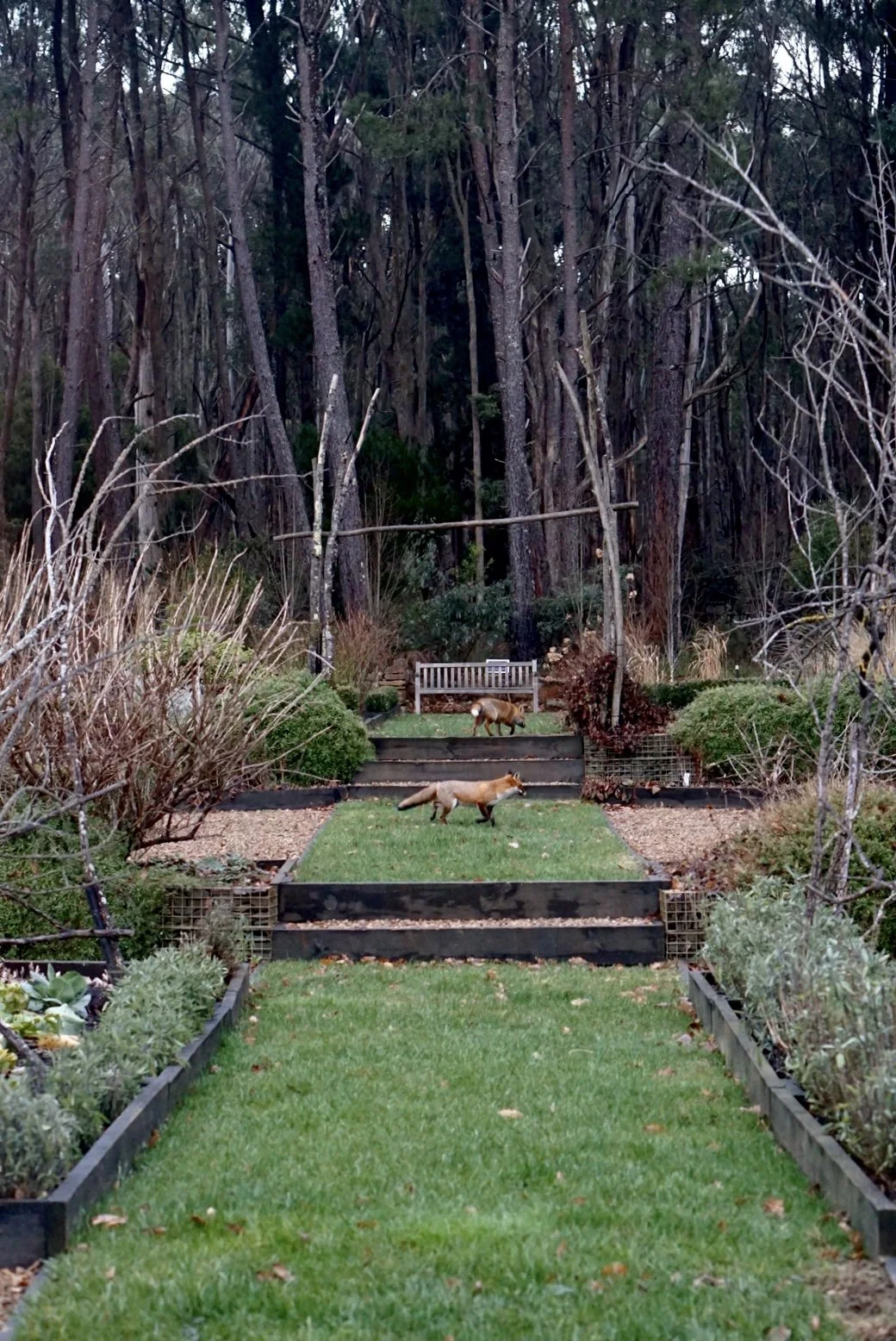
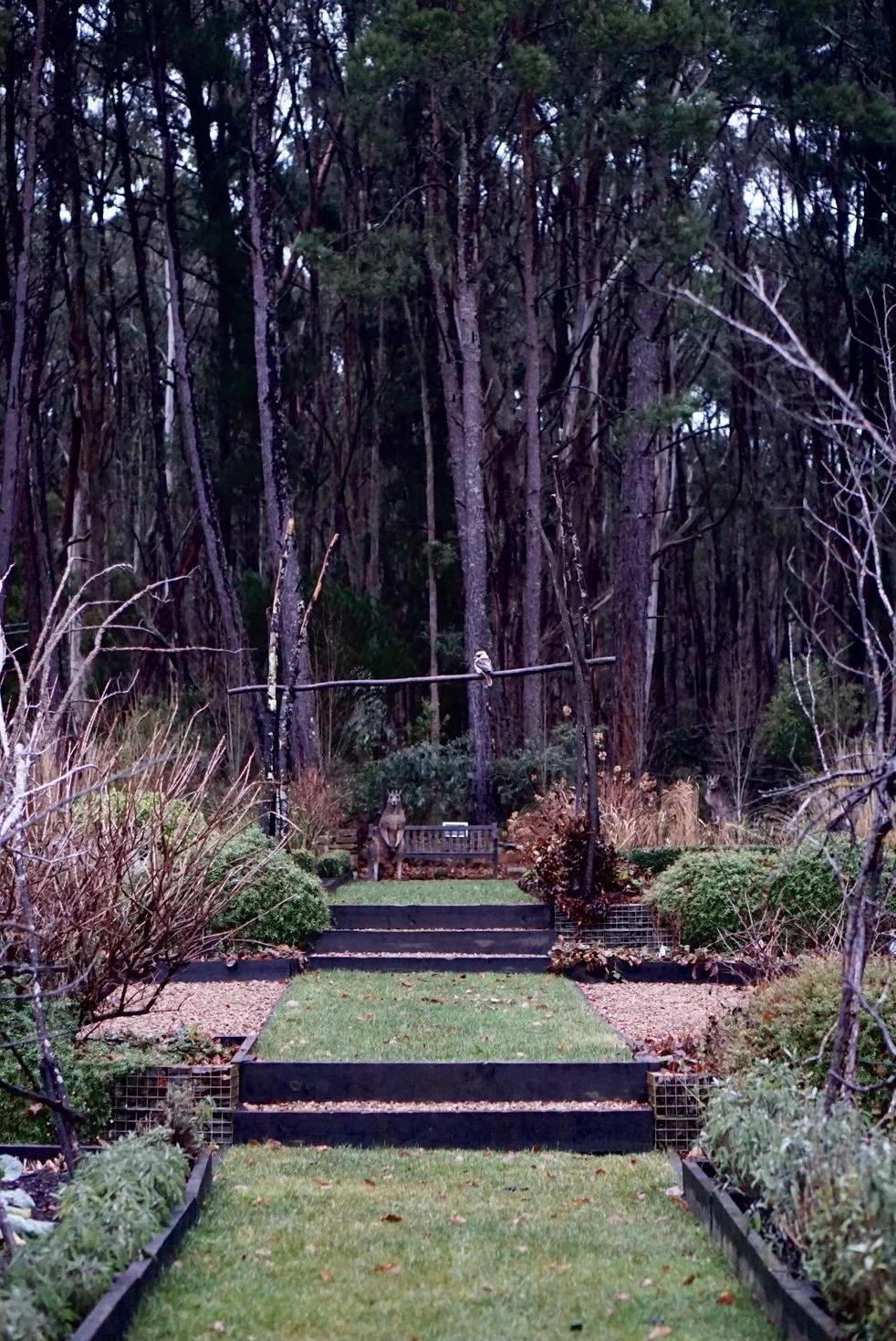
Oak & Monkey Puzzle - view down lawn spine to forest backdrop
What Winter Shows You
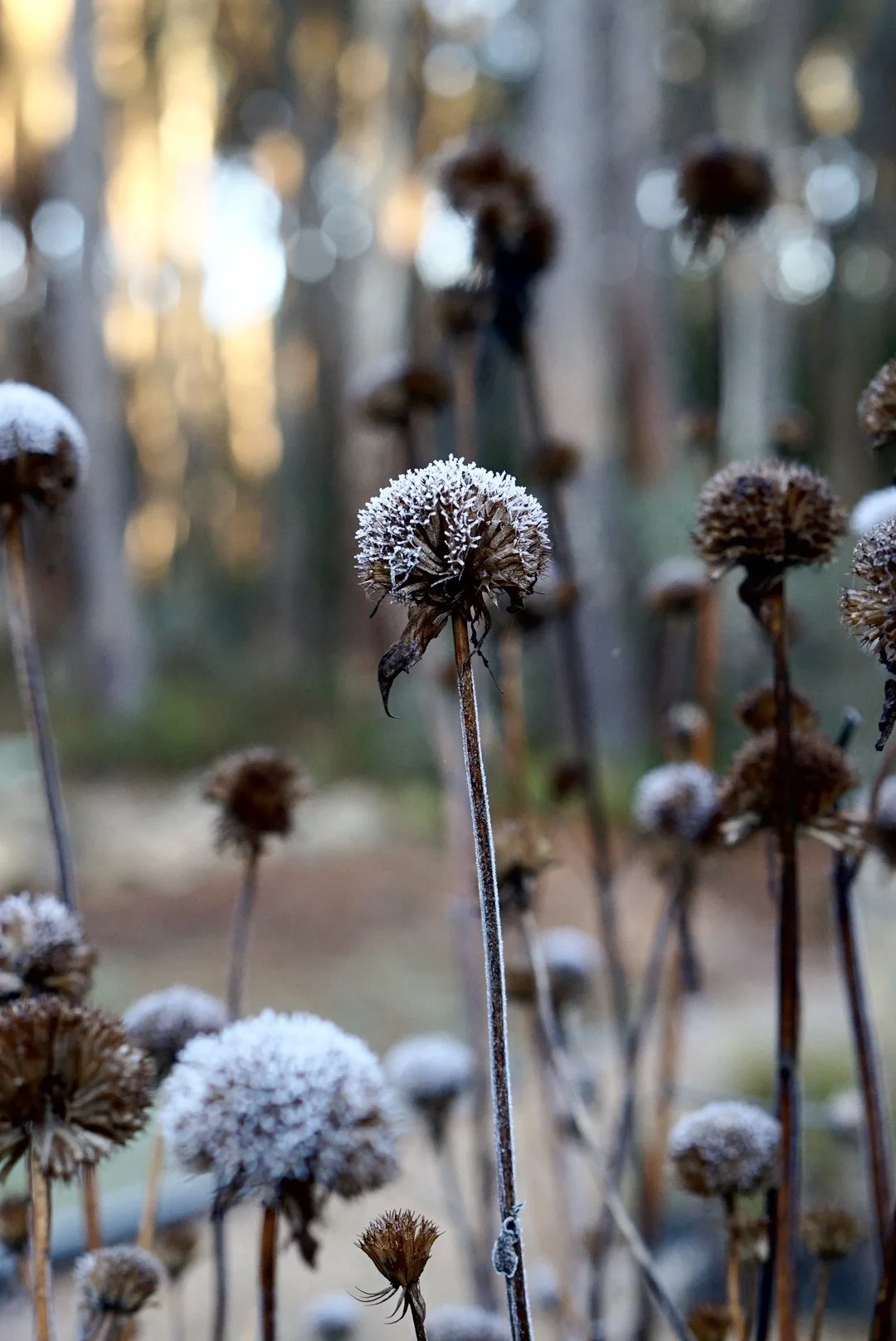
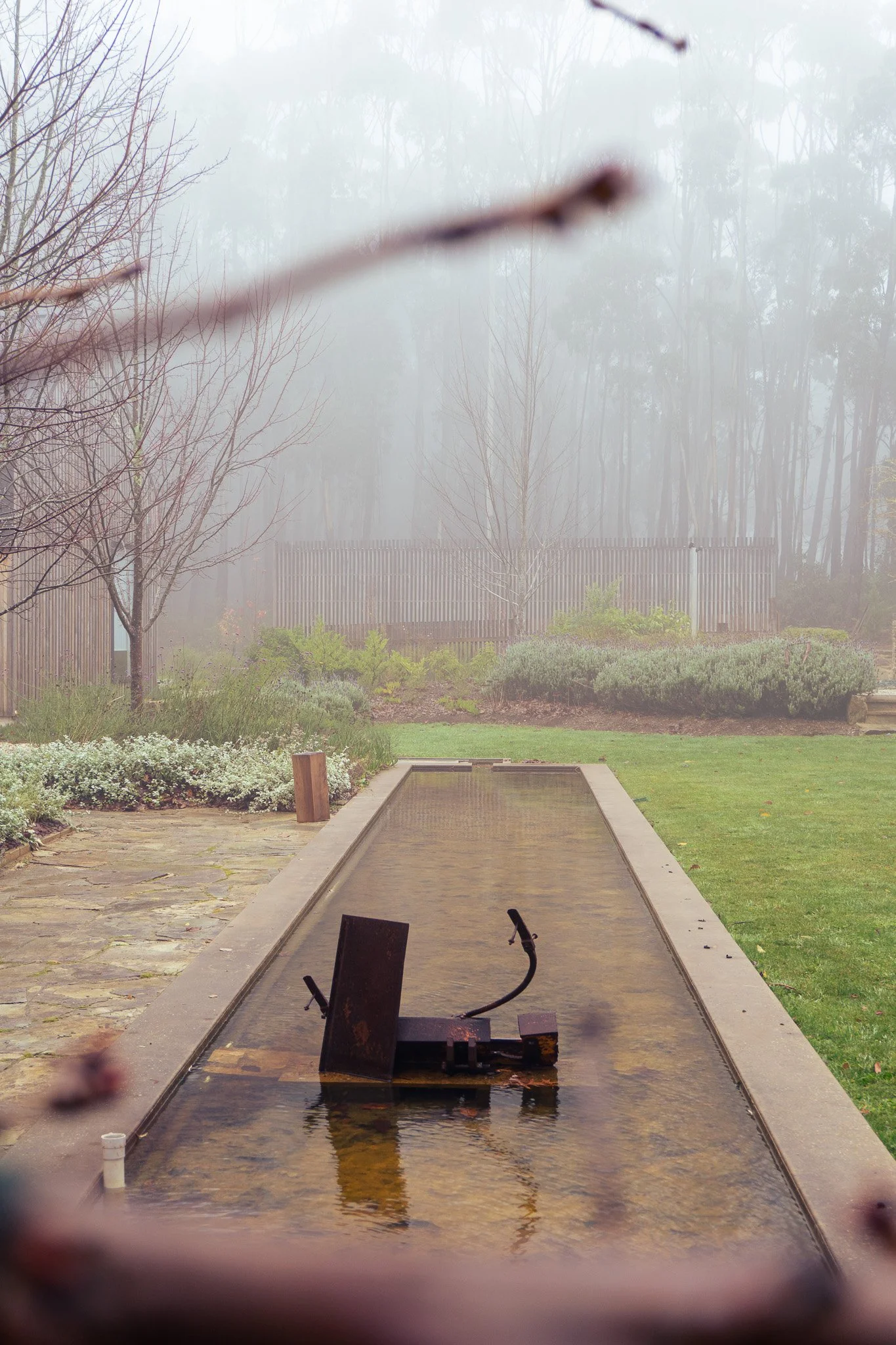
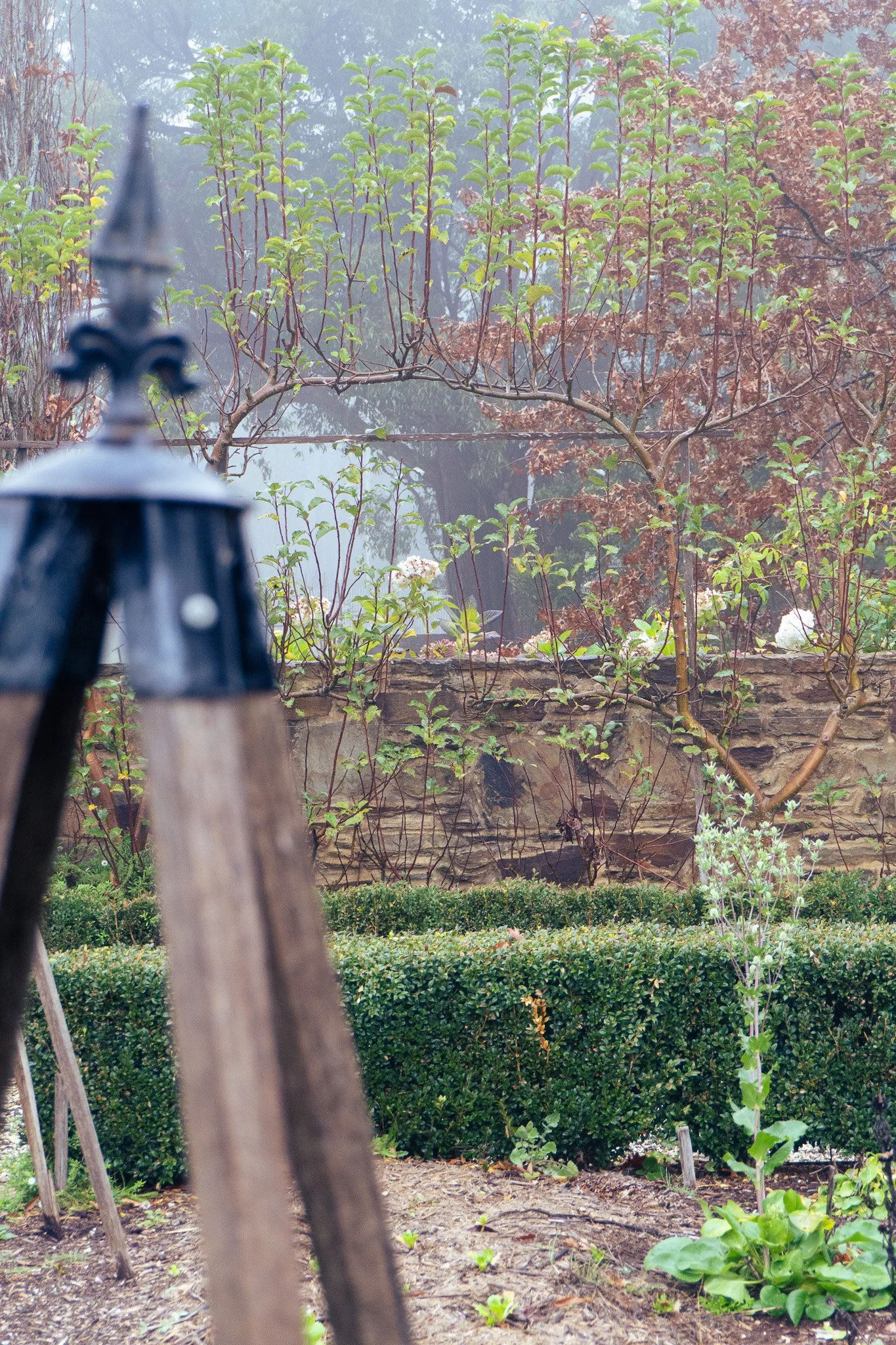
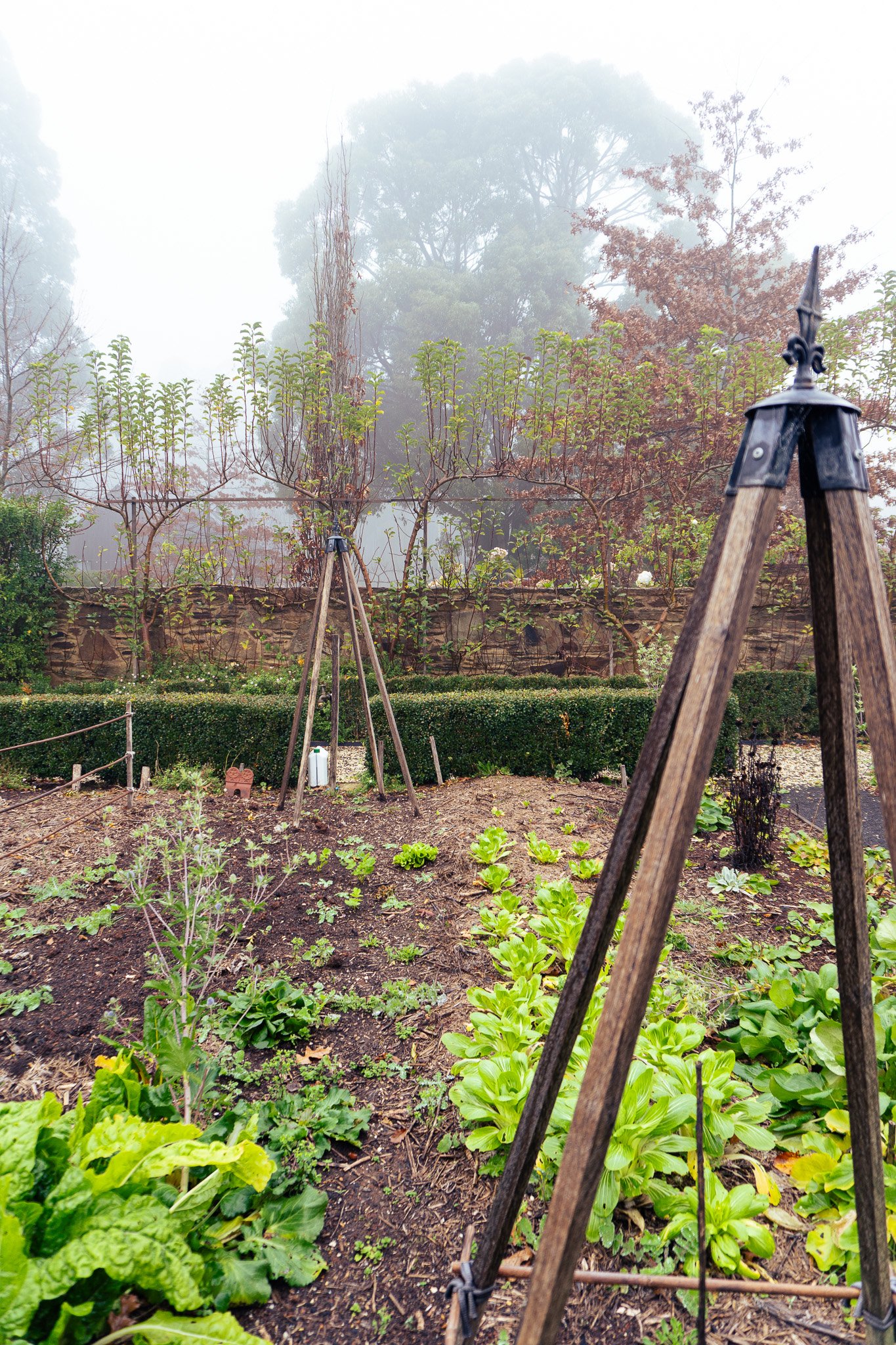
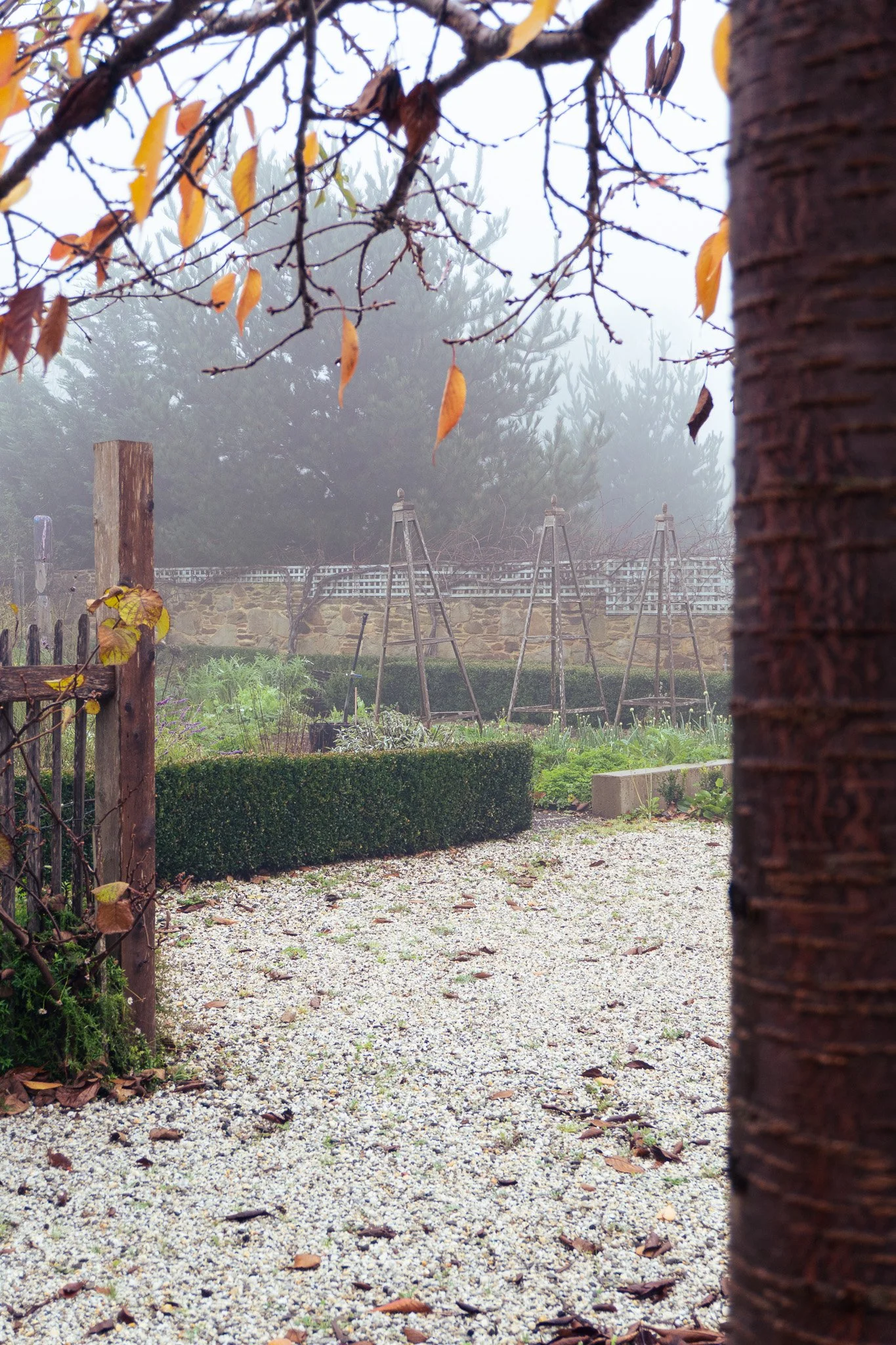
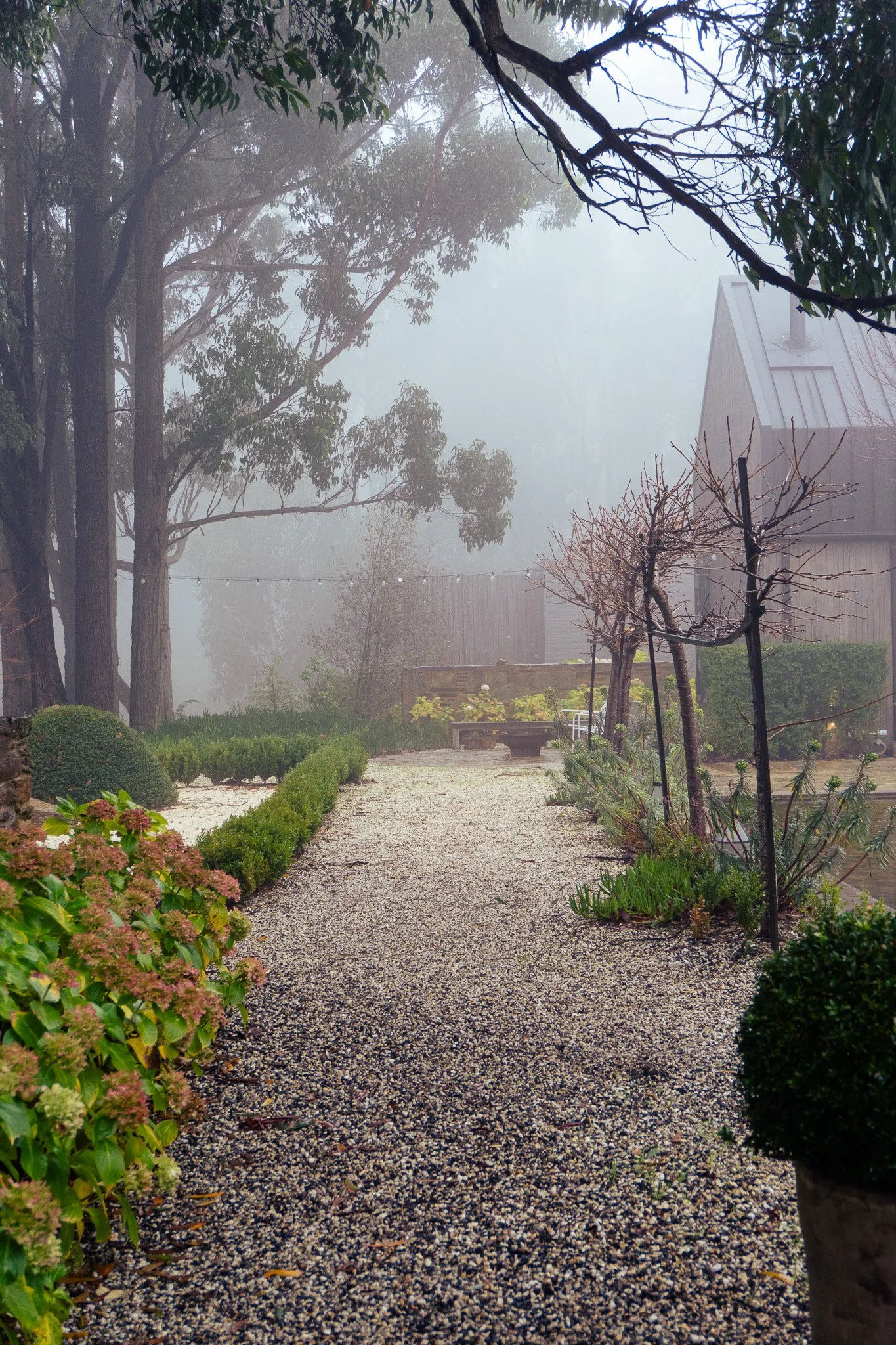
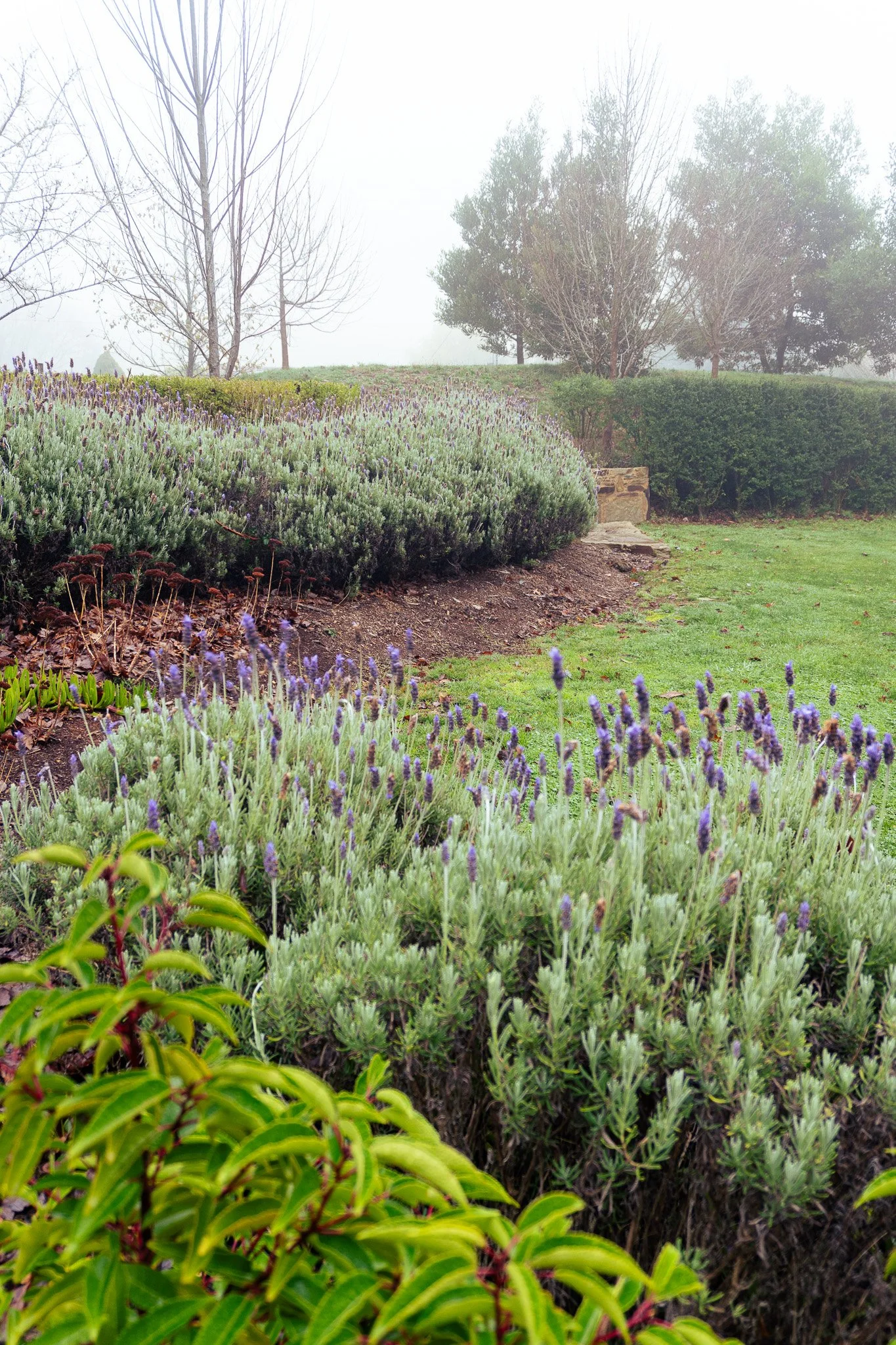
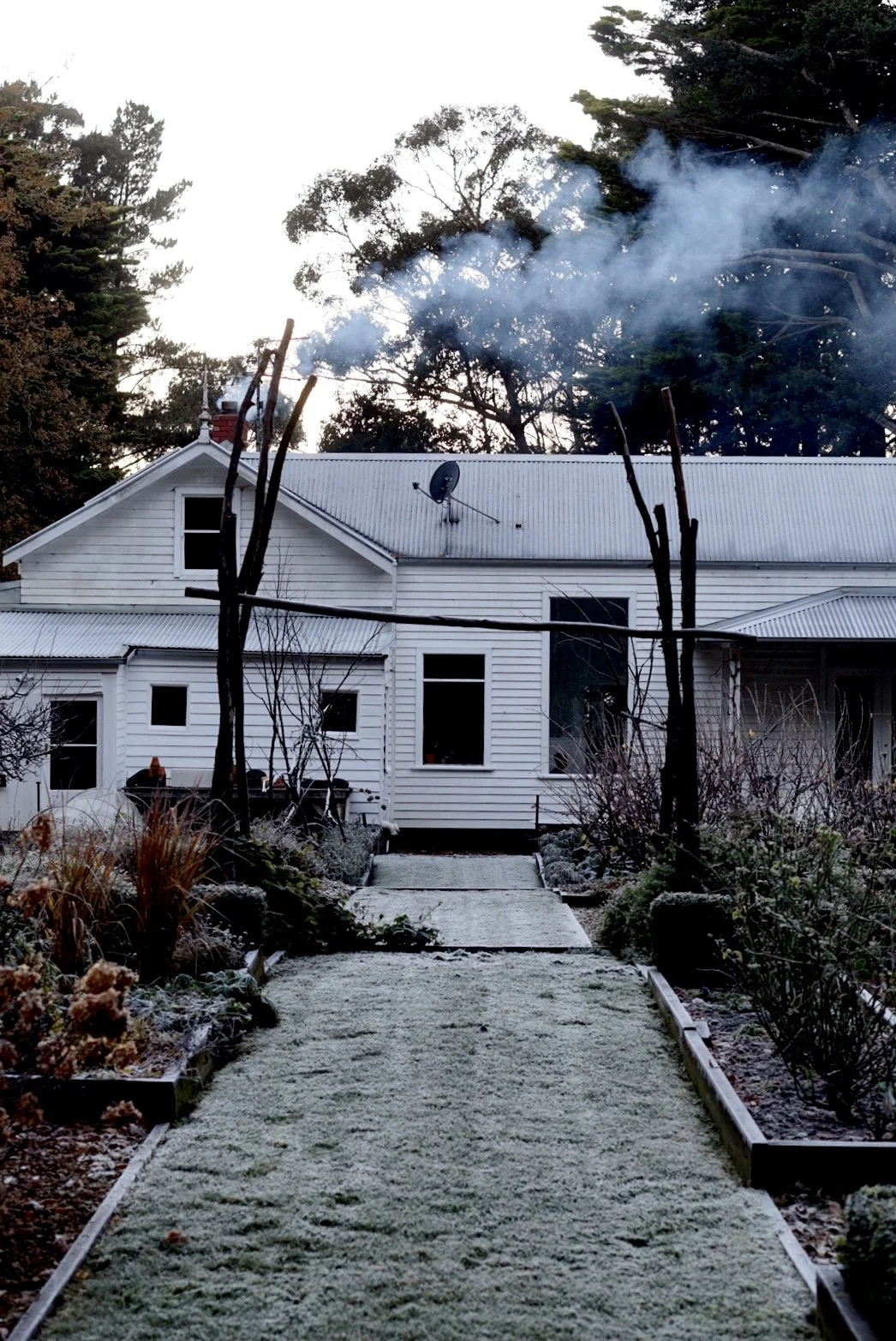
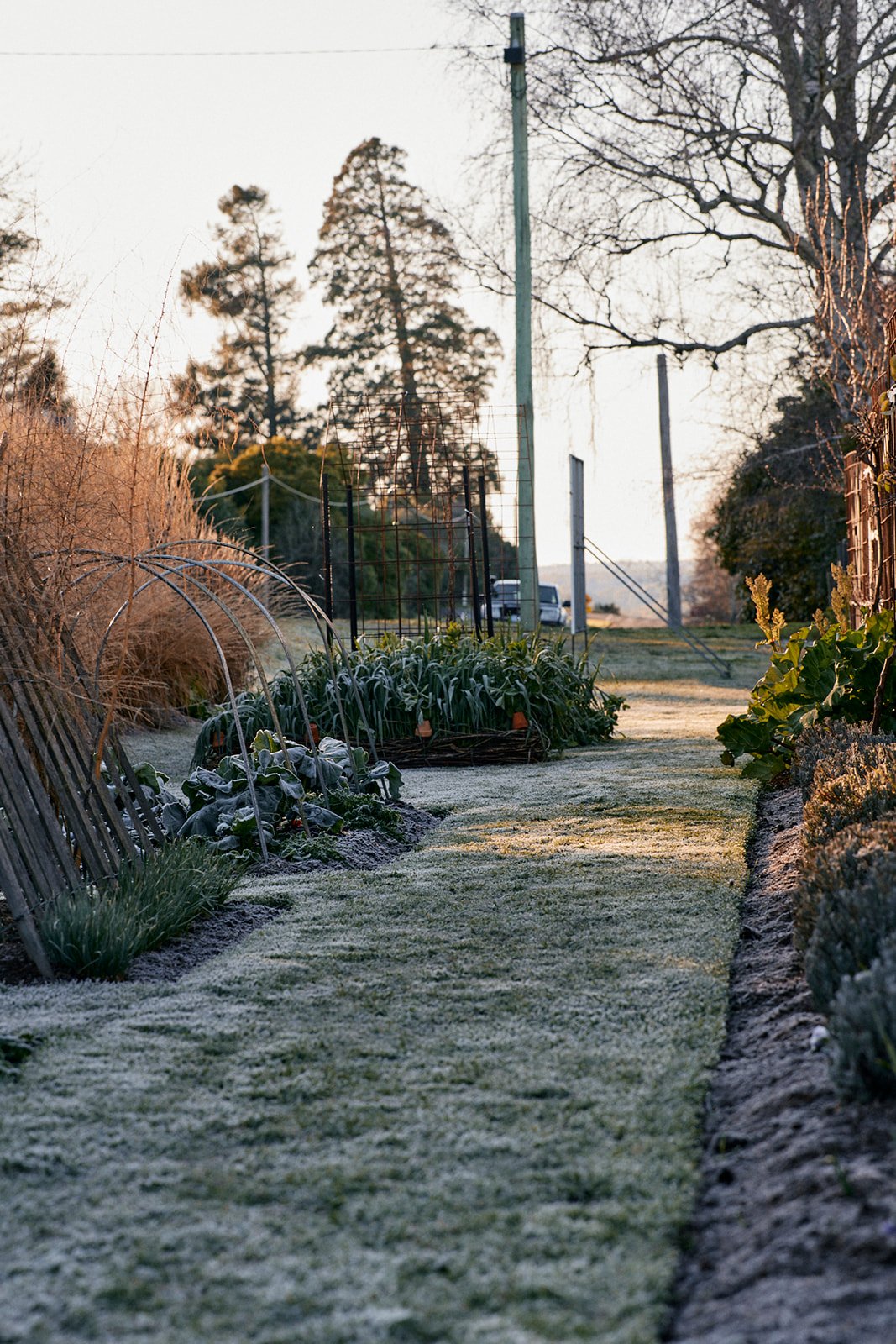
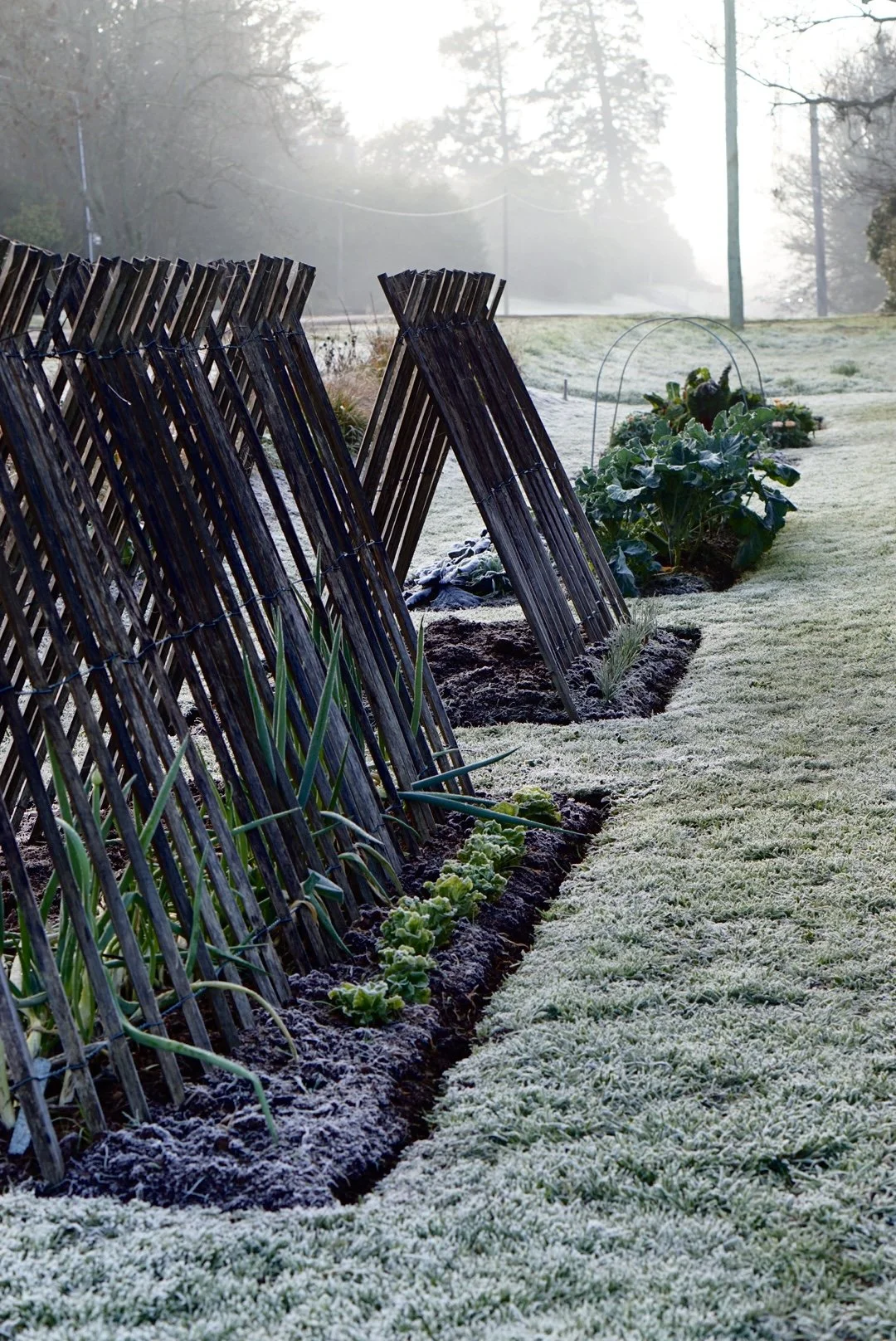
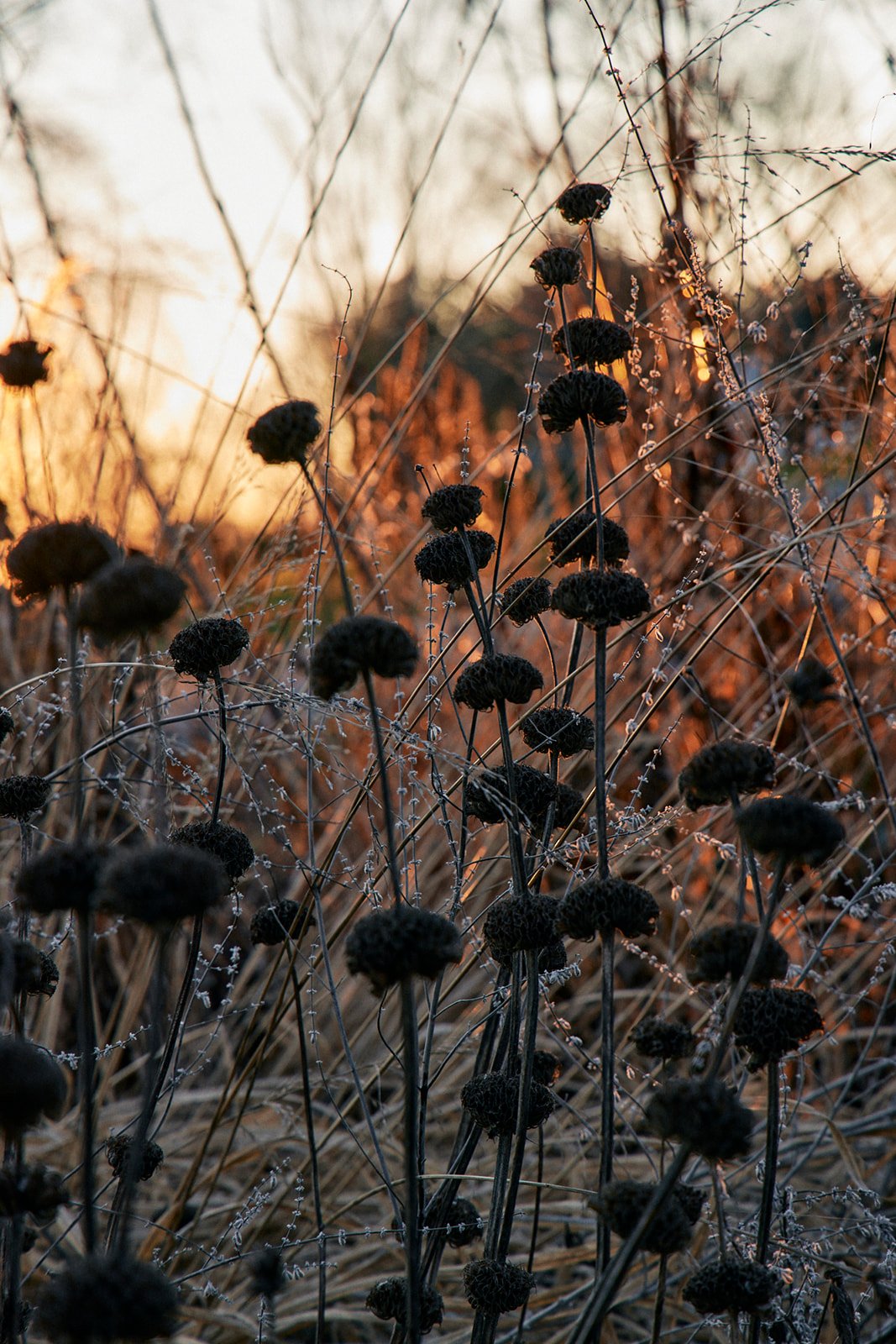
On the coldest mornings I take the same short walk around my garden before the day begins, and the lawn is the first thing I see. A crust of frost across the open grass, holding the low light, keeping the shape of every blade until the sun finds it. The garden at Little Cottage on a Hill is only five hundred and fifteen square metres, and on a morning like that it gives itself up to me completely. The grass reads as a kind of ground. The bare espalier along the fence becomes a drawn line. The trees are tone and mass and the spaces between them. Everything has been stripped of its colour, and in that stripping I can see, with almost embarrassing clarity, what holds the garden and what does not yet anchor it strongly enough.
Years ago, before my daughter was born, I spent Tuesday nights learning to paint in a studio in Clifton Hill — a converted stairmaker's factory that smelled of linseed oil and cigarettes and whiskey, where an esteemed old painter named Des set me the same task again and again. The underpainting. Before any colour, the old painters laid down a monochrome ground: the whole composition resolved first in greys, in light and dark, so they could see whether it held before a single true colour was allowed near the canvas. I did not understand, then, that I was being taught how to look at a garden. I understand it now, every July.
This is the thing I most want to say about winter, and I want to say it plainly, because it runs against the grain of how we are taught to feel about the season. Winter is not the garden at its emptiest. It is the garden at its most honest. You would be amazed how much a winter garden can teach you, if you let it. It takes away the froth of summer — the colour the eye runs to first, the abundance that papers over a weak structure — and leaves the bones exposed. It asks the one question every gardener tends to avoid and every designer should be asking: does this hold on its own terms, beneath everything I have laid on top of it?
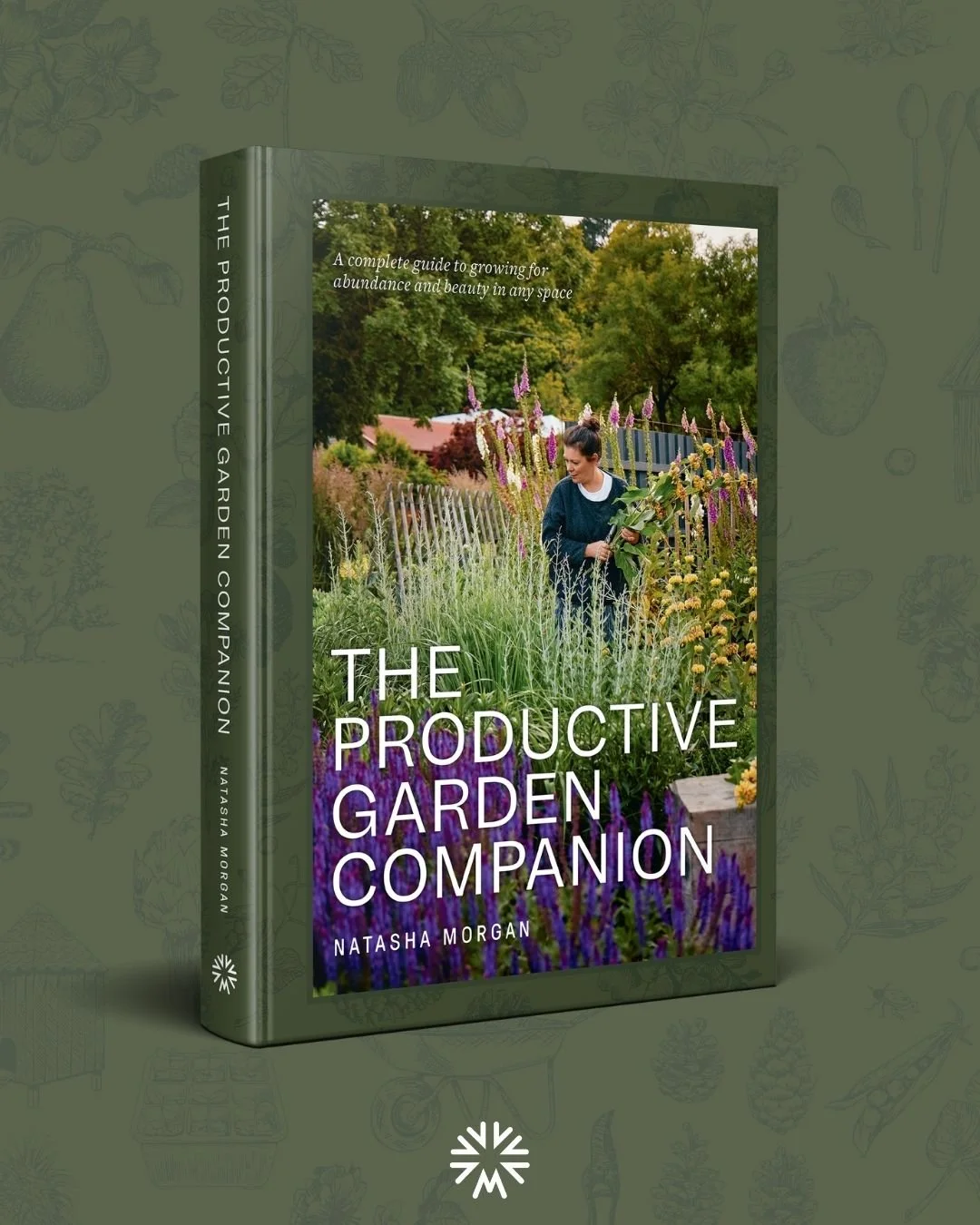
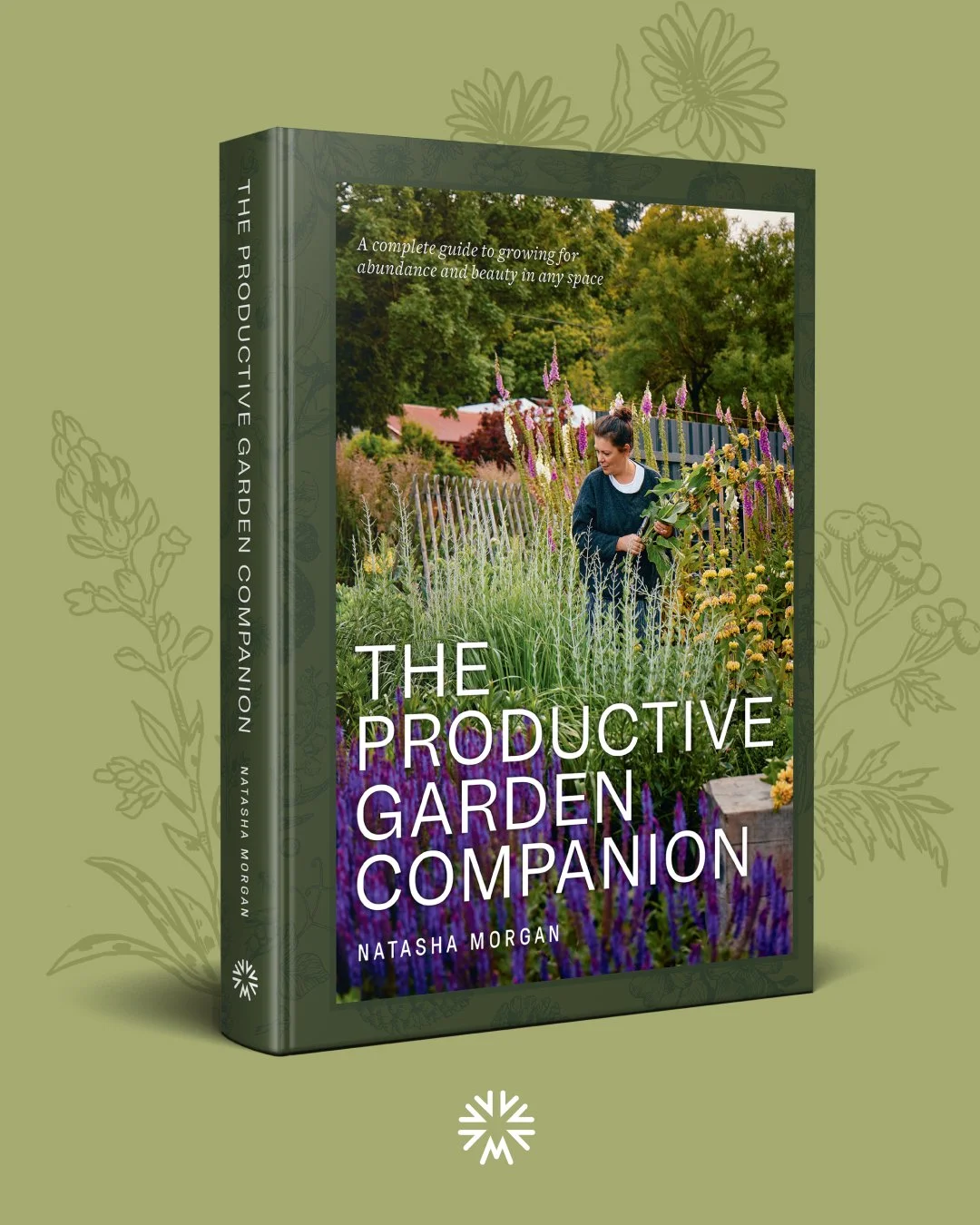
I came to that question the long way round. I have been a gardener since I was a child, loving the plants themselves — their beauty, the small triumph of coaxing something difficult into growth — long before I knew anything about design. Design came later, through study and then through fifteen years of practice, learning to read space before planting: mass and void, the way one volume sits against the next. What took me far longer to see is that winter performs that reading for you, for free, once a year. When I was finishing my book, The Productive Garden Companion, and battling with the cover direction as most authors do, I’m told, artist and friend Andrew O'Brien stripped its cover to black and white, to test it — because colour is the most seductive thing in any image, and only with the colour gone is the eye forced onto whether the composition is genuinely well made or merely attractive. That is precisely what winter does to a garden.
I am in good company here. Piet Oudolf, whose plantings have done more than anyone's to rehabilitate the idea of a garden in winter, chooses a plant as much for how it dies as for how it blooms — the echinacea for the cone it leaves behind, the miscanthus for the plume that frost turns to a small sculpture. Dan Pearson writes about the moment in autumn when you finally take your hands off the reins and simply look. Arne Maynard says that only in winter, stripped of its summer froth, can the true layout of his garden be seen for what it is. None of them is mourning a gap. They are describing a season of revelation that the rest of the gardening world has somehow agreed to call empty.
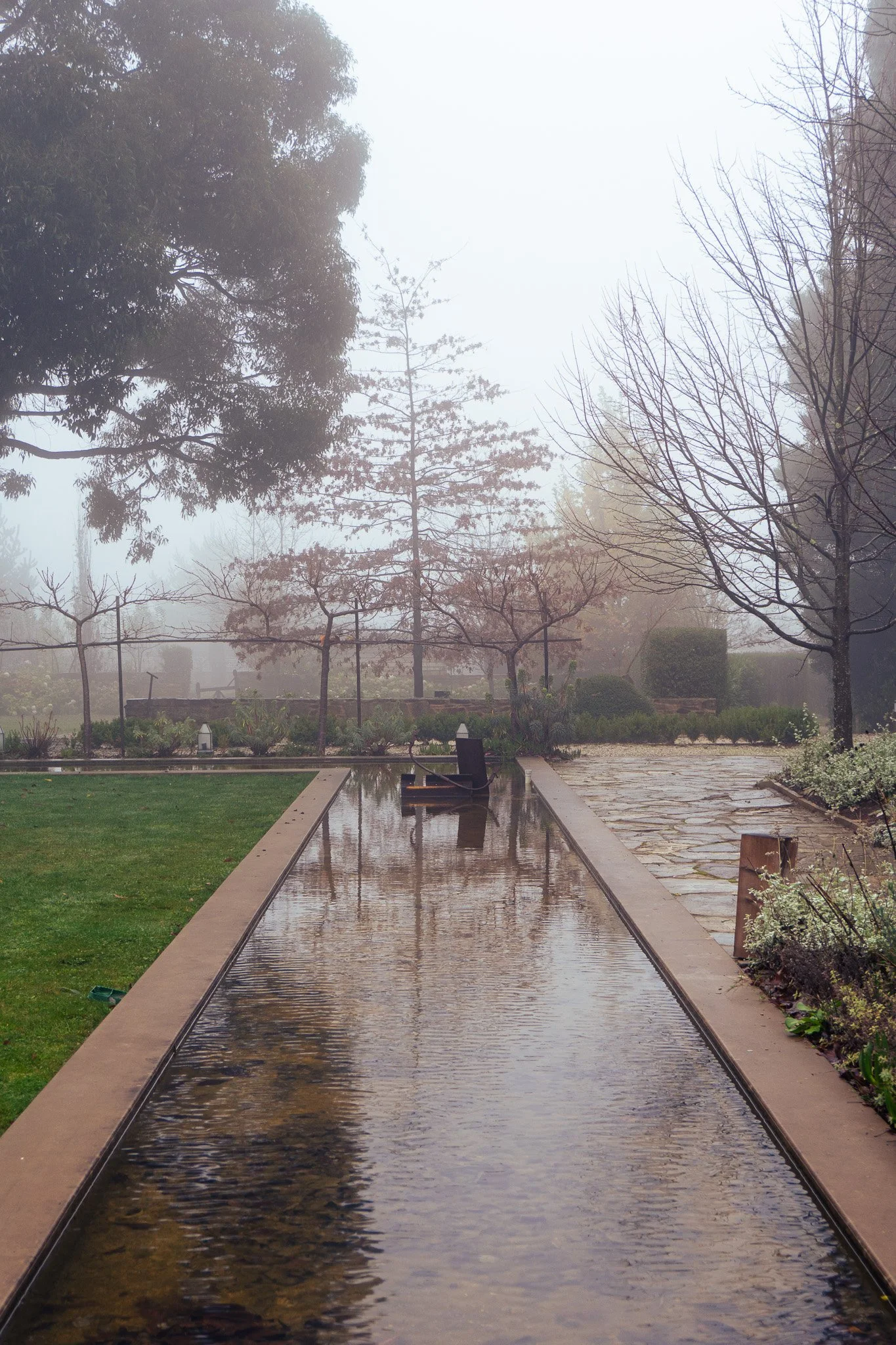
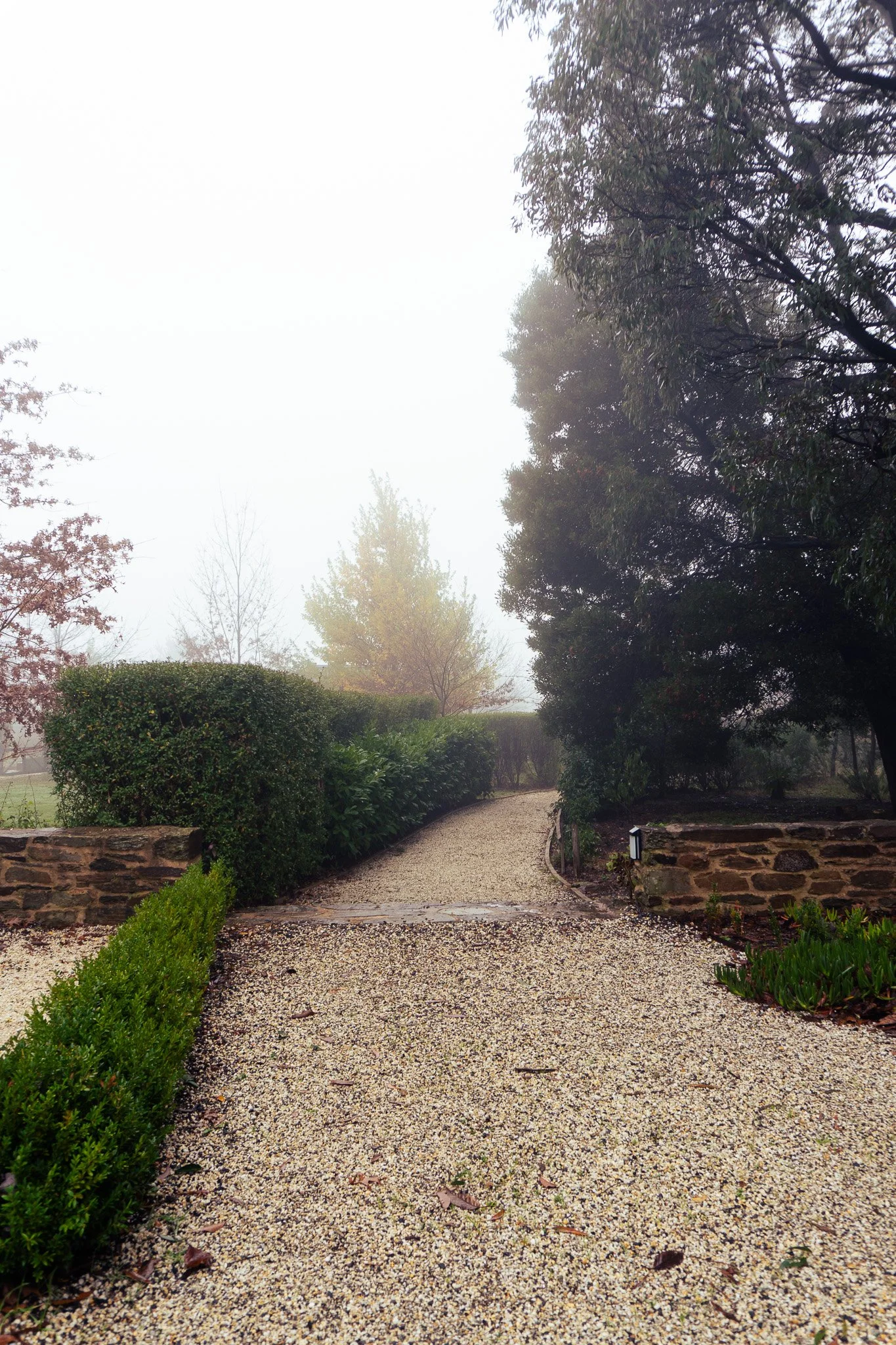
It helps that I garden where I do. There is a particular gift in this volcanic country of the Victorian Central Highlands, and it only becomes fully visible in the cold. Deep fog and real frost most mornings, settling in the low places and silvering everything they touch. A low, raking light that comes in almost horizontally and finds the texture in everything it crosses. From my garden I can see the old trees on Wombat Hill standing against a pale sky, reading almost like a wall beyond the fence. Five minutes away at Musk, where it snows some winters, Andrew has spent years making Stonewalls — twenty-five acres of garden and bushland shaped through a painter's eye.
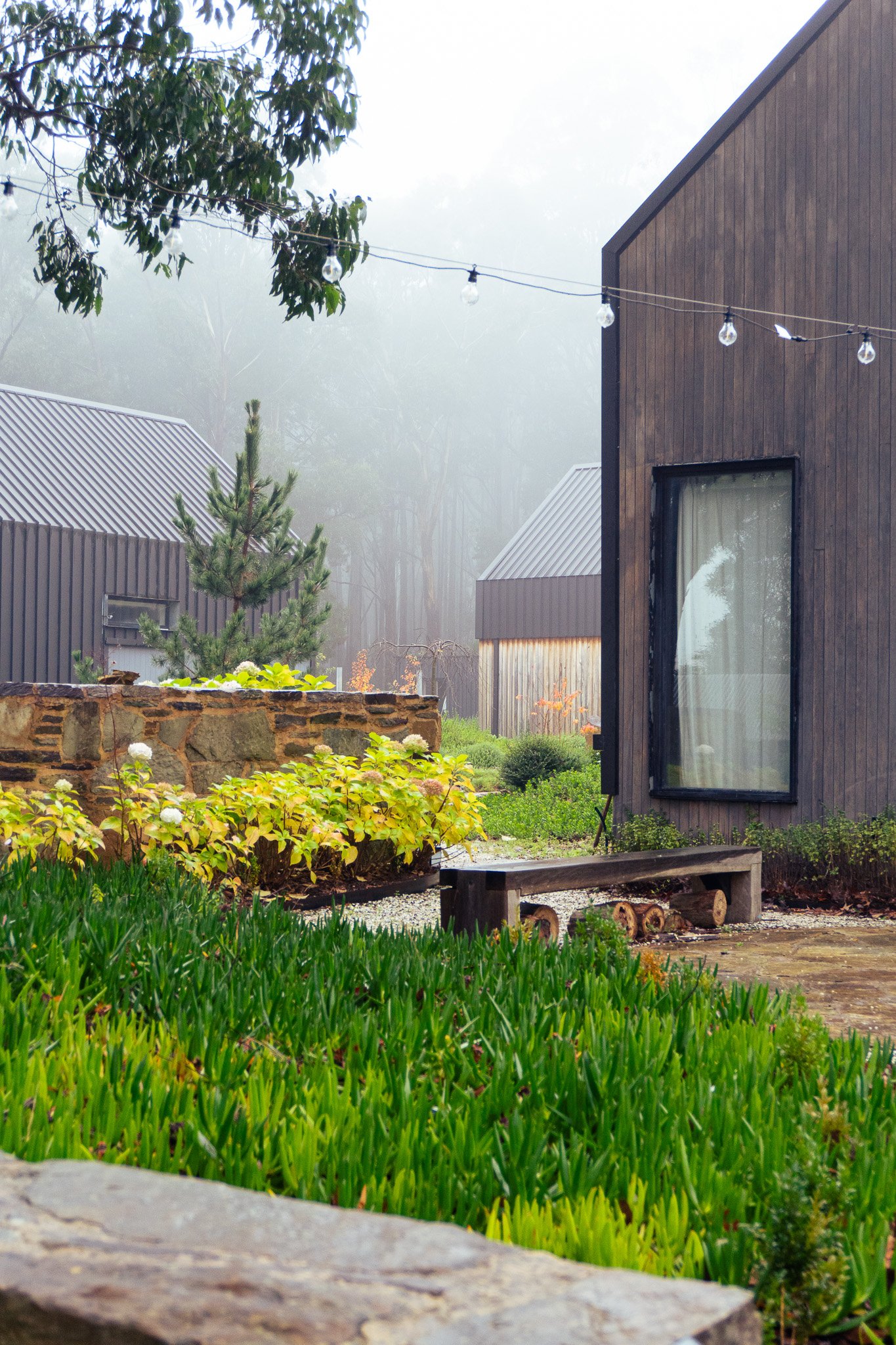
He comes to structure from the opposite direction to me, through paint, and he reads the gaps in a garden as the load-bearing parts: the space between two bare branches, the void between one plant and the next, the thing that gives a composition its tension. The black barn buildings he has set across the land do the same work as Des's monochrome ground. They hold the colour the way an underpainting holds the bloom.
I have tested this at both ends of the scale. At Oak & Monkey Puzzle, my old five acres at Spargo Creek, the gesture that organised the whole garden was a long sweep of open lawn — a spine — and it was every winter, when the planting drew back, that I could see whether it still held the place together. The emptiest part was the most important part. The frost-crusted lawn at Little Cottage on a Hill now teaches me the same lesson in miniature, small enough to take in at a single glance.
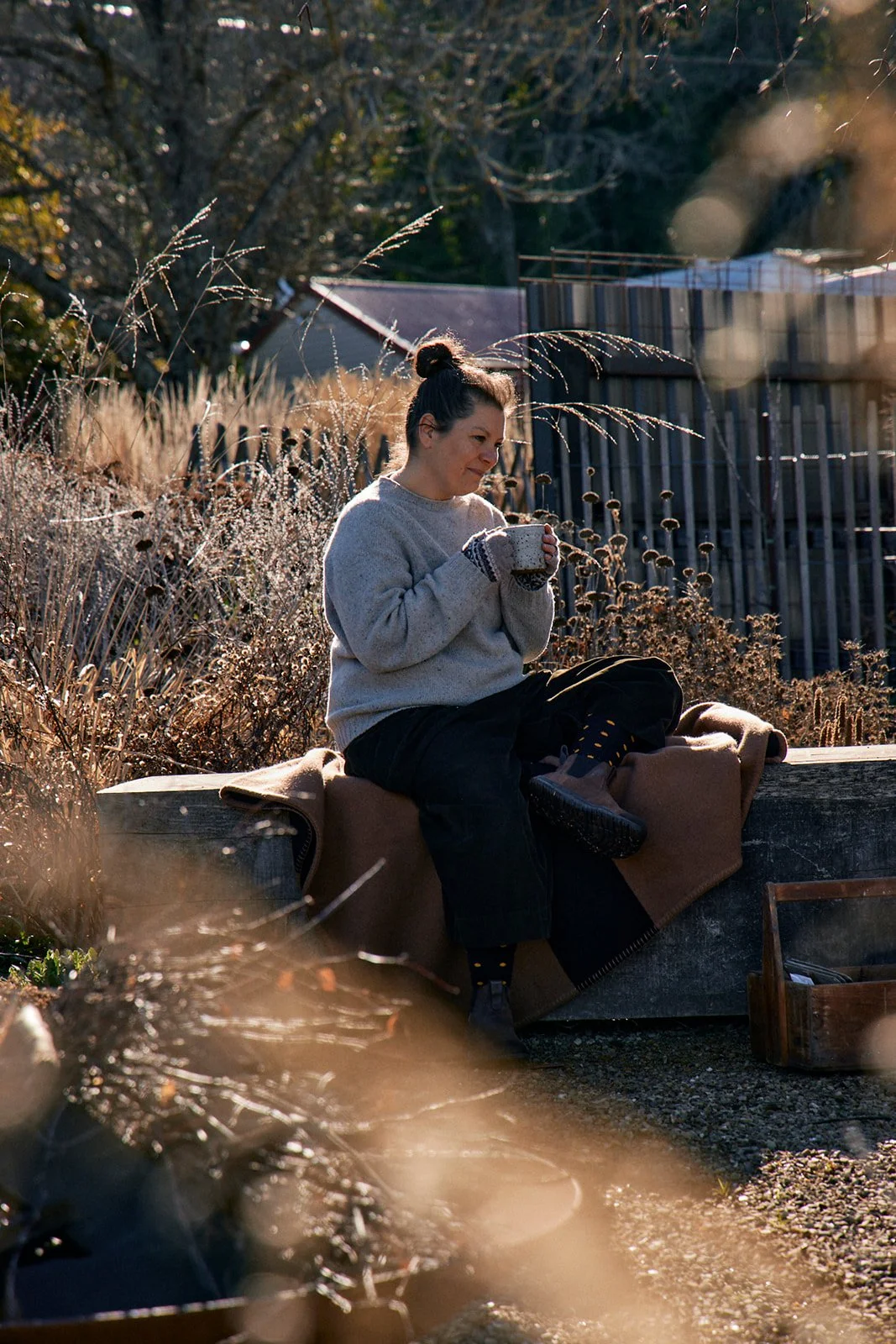
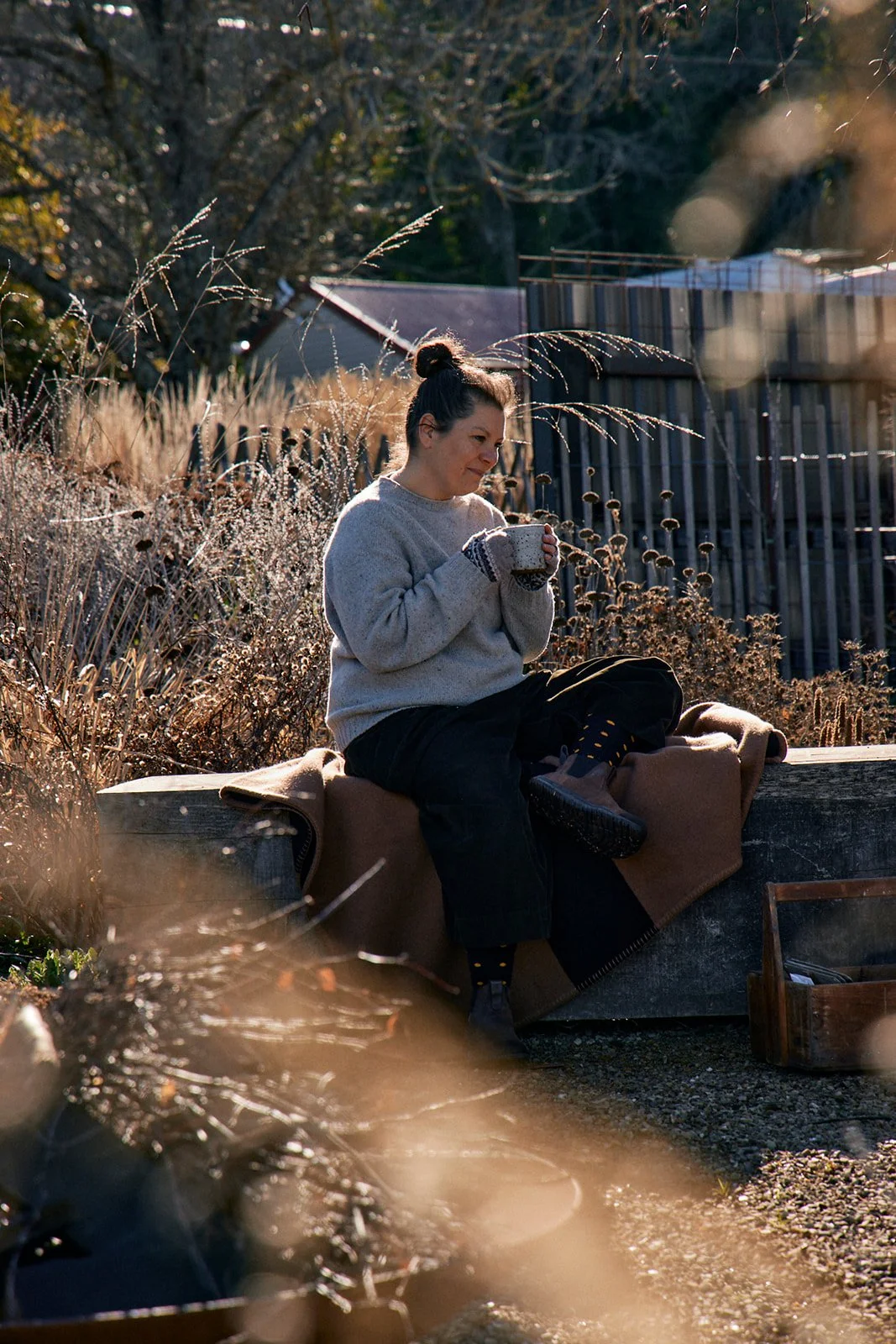
People think of winter as the end of the gardening year. Since leaving city life and learning to live with the land, I have never been able to feel it that way. For me it is the prelude — the season of greatest promise, the months I spend dreaming and planning before anything is asked to grow. I sit with a cup of tea and I look: where the frost settles, where the structure isn't yet holding. You lay the monochrome ground first, in the cold, and everything bright comes afterwards, and comes better, because of it. This is the thinking that runs underneath my book, The Productive Garden Companion — that you plan by observation rather than by dates, and that the quiet seasons are where the foundations are laid. It is also what Andrew and I are opening both our gardens for, on a single and rare Sunday in July: a day to put your hand on a cold wall and your eye to a stripped border, and feel the argument for yourself.
The sun reaches the lawn eventually. The frost lifts in the first hour, and by then the garden is already reorganising itself in my head — the greys turning into a map of what they will hold once the colour comes back over the top.
Winter Structure Masterclass — with Andrew O'Brien of Stonewalls and Natasha Morgan.
Sunday 12 July
10.30am–3pm
Little Cottage on a Hill, Daylesford & Stonewalls, Musk
Limited to 25 places
Continue your gardening journey with me
If you enjoy this kind of content, my workshops offer more detail and guidance on design, productivity and seasonal care.
If you are building your garden from home right now, my e-books on Wicking Bed Gardens, Introduction to Backyard Chicken Keeping and Compost for Beautiful Productive Gardens offer practical step by step guidance that pairs well with the workshops.
I share seasonal tips, behind the scenes at Little Cottage on a Hill, and new resources through my newsletter. Subscribe to receive my entire plant list from the garden as a personal thank you.
You can also pre-order my book The Productive Garden Companion, the book I have wanted to find my entire life. A complete guide to growing for abundance and beauty in any space. The Productive Garden Companion is a practical, reassuring and visually rich modern gardening book that meets gardeners wherever they are, from windowsill pots to generous acreage.
You may want to check out my related content below:
Looking Back - A Rare Glimpse Inside Oak and Monkey Puzzle
My top 5 plants - from Oak & Monkey Puzzle
Lessons in Abundance - Life at Little Cottage on a Hill
Stay connected for more seasonal inspiration:
Instagram | Facebook | Gardenstead | LinkedIn | Pinterest | YouTube | Website | Newsletter
Thanks so much for following along.
Natasha xx
Feijoas: the fruiting hedge that gives back
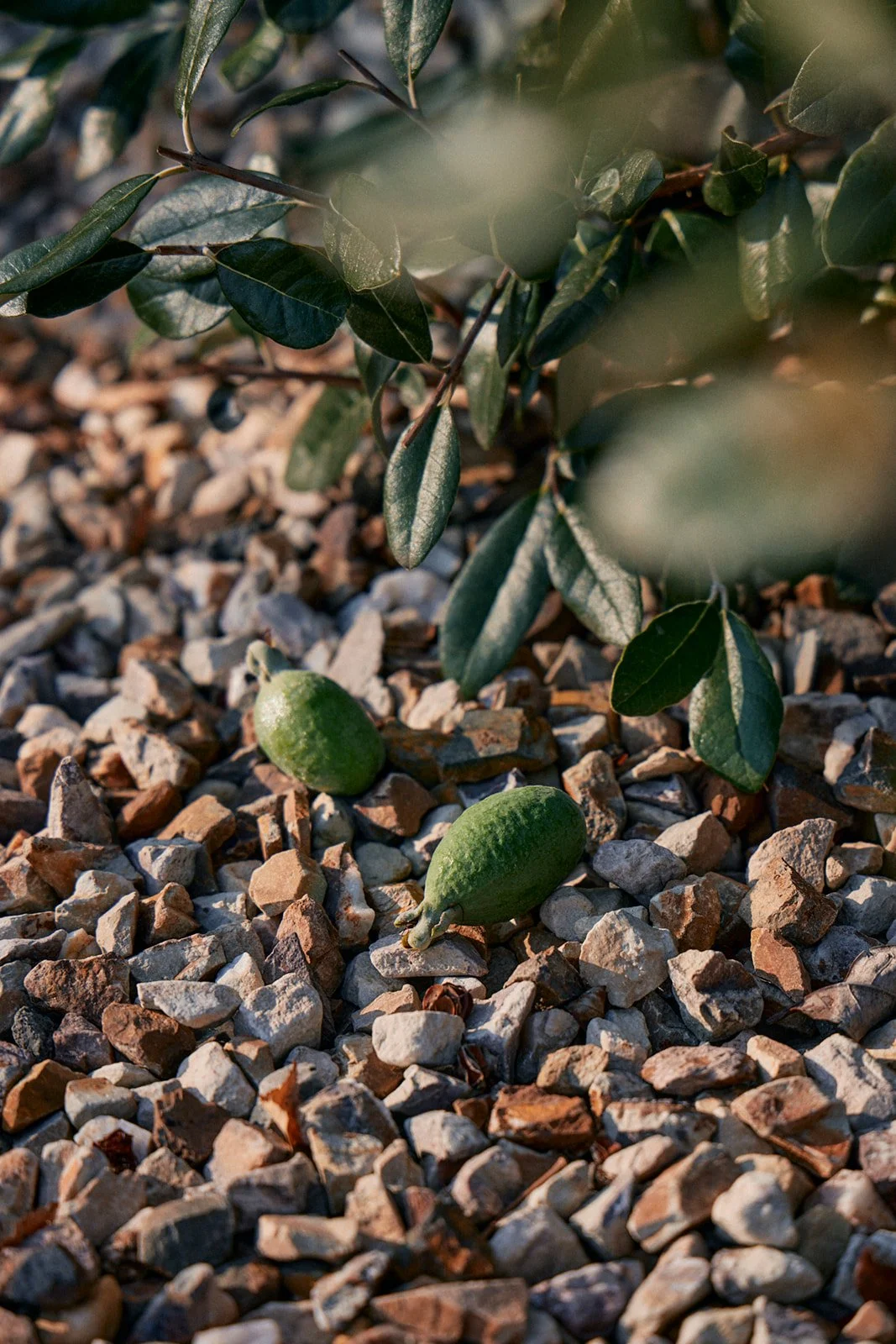
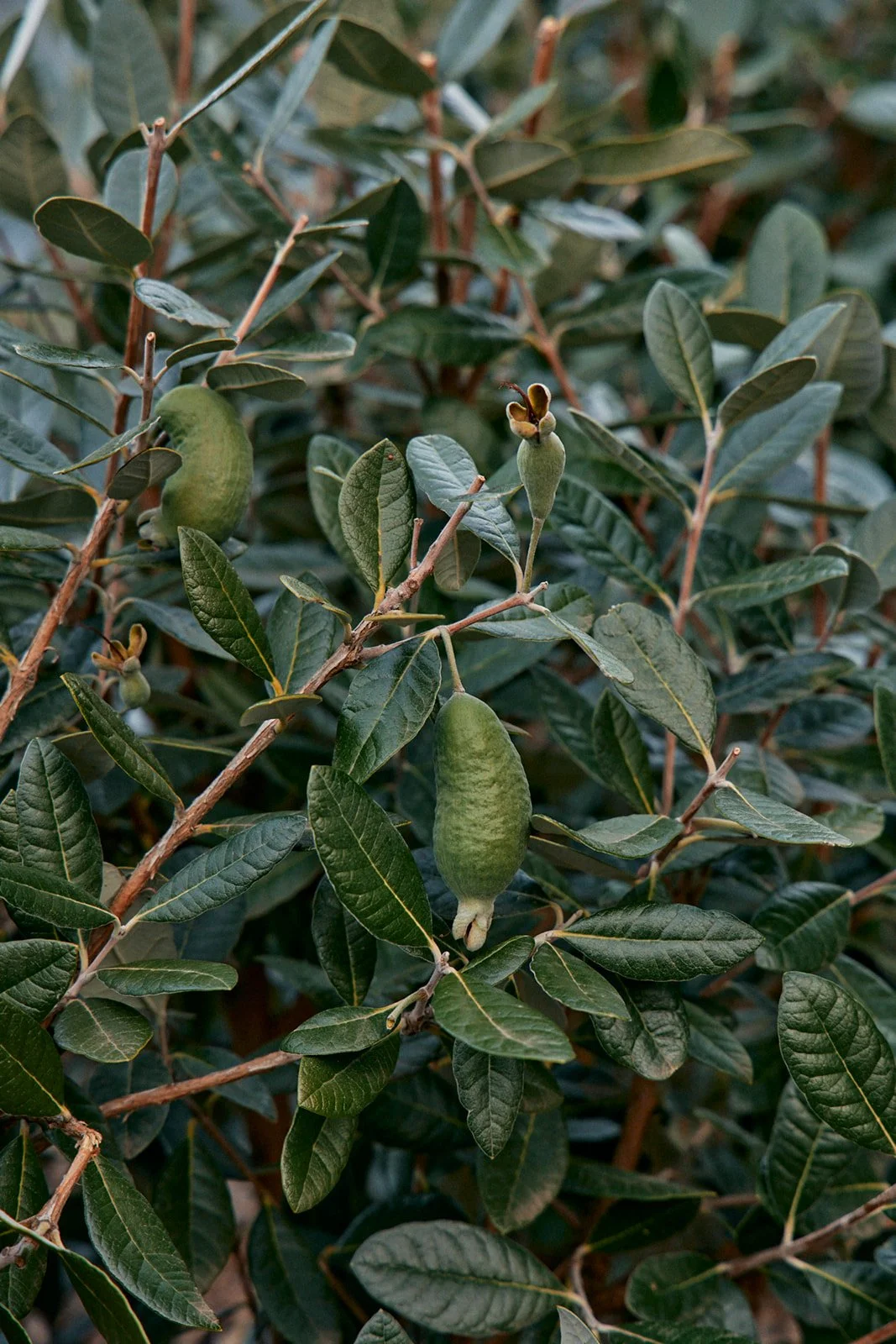
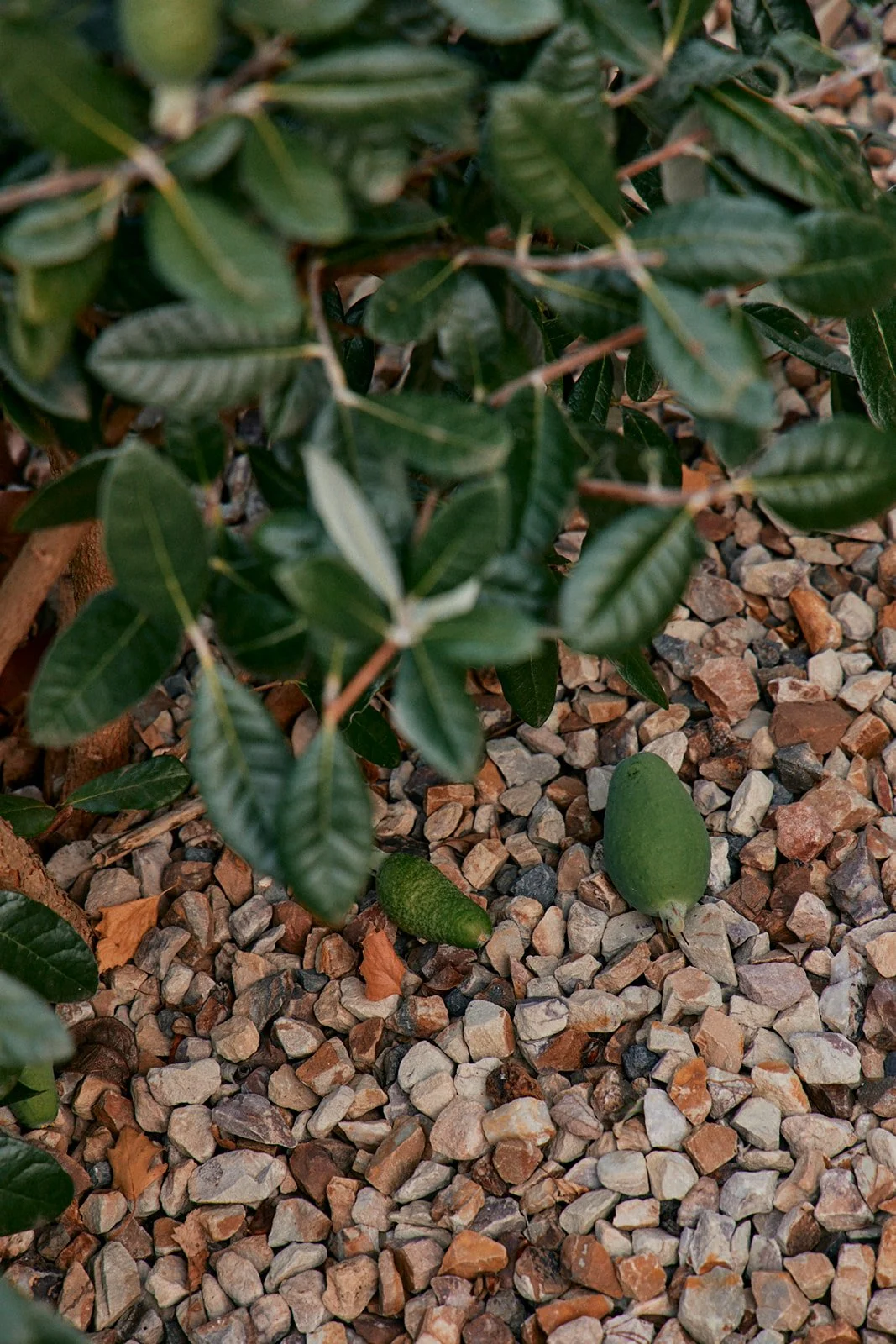
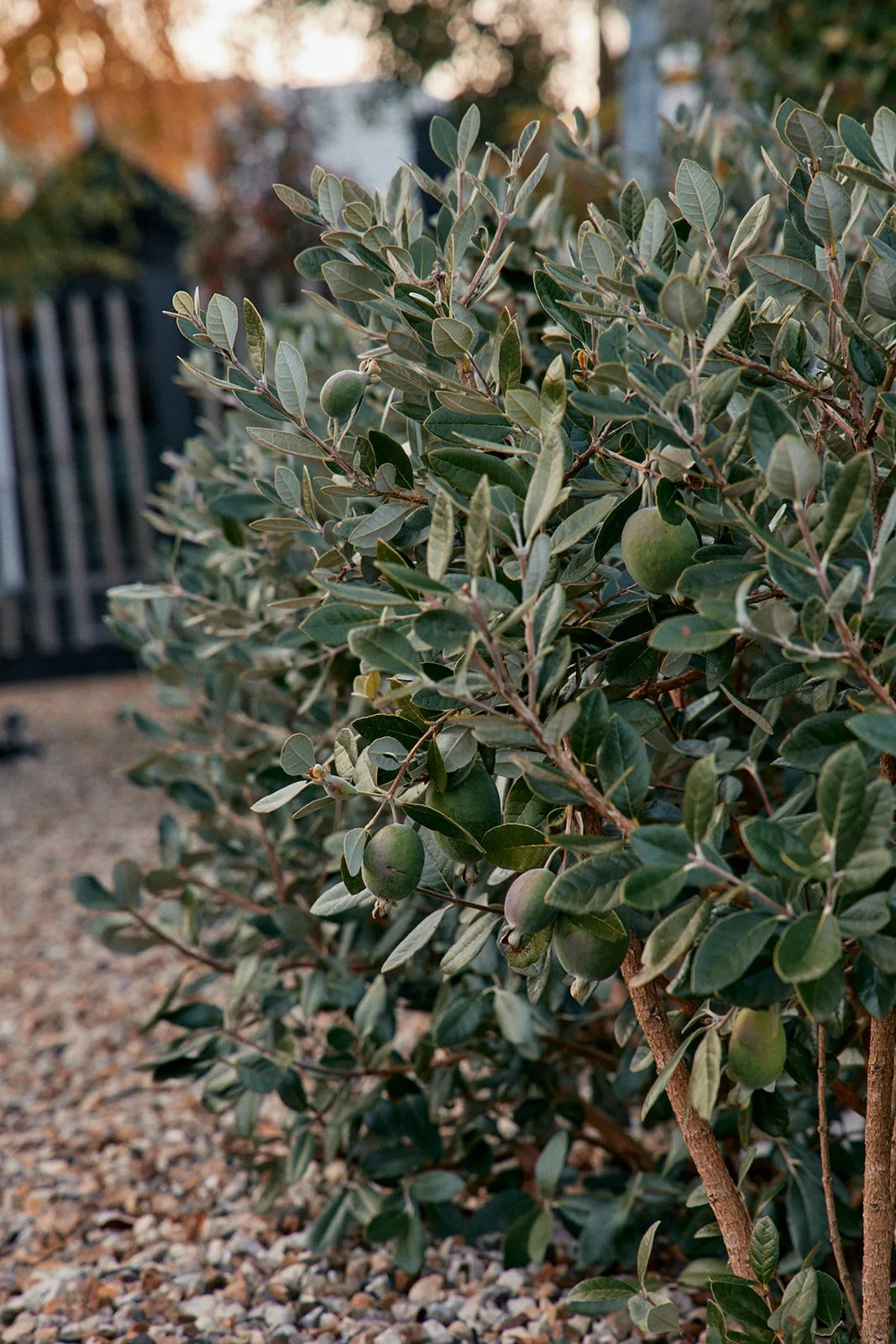
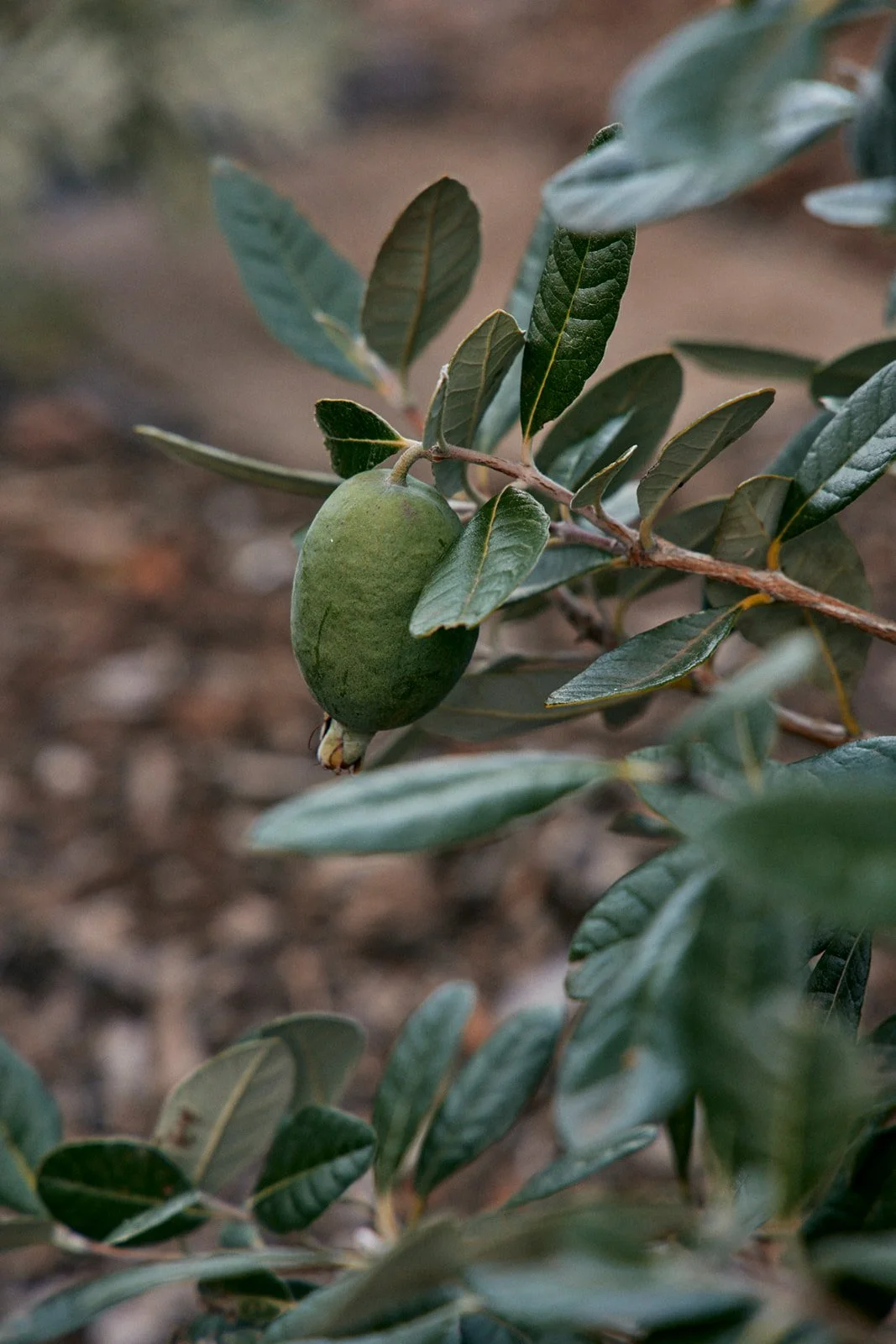
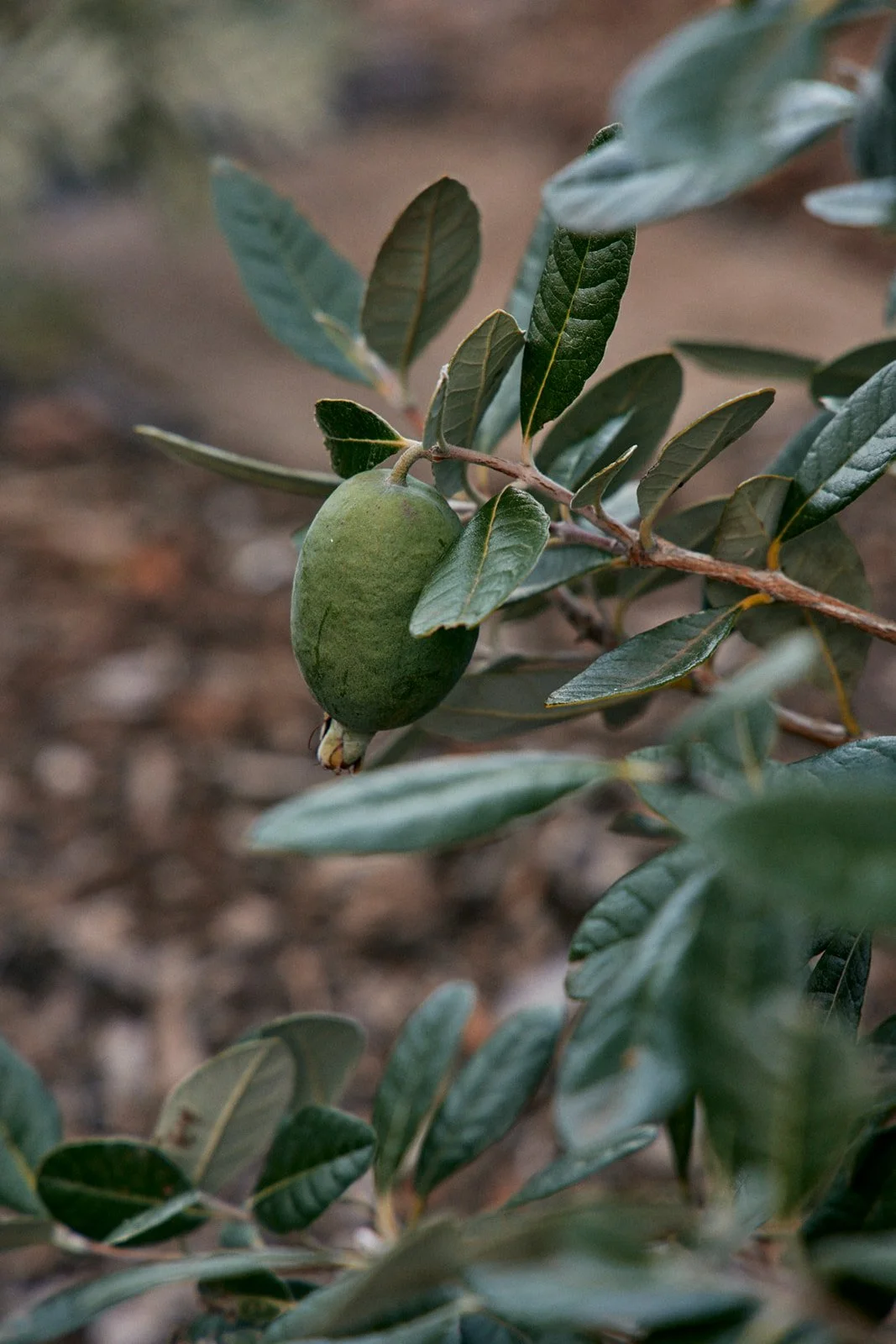
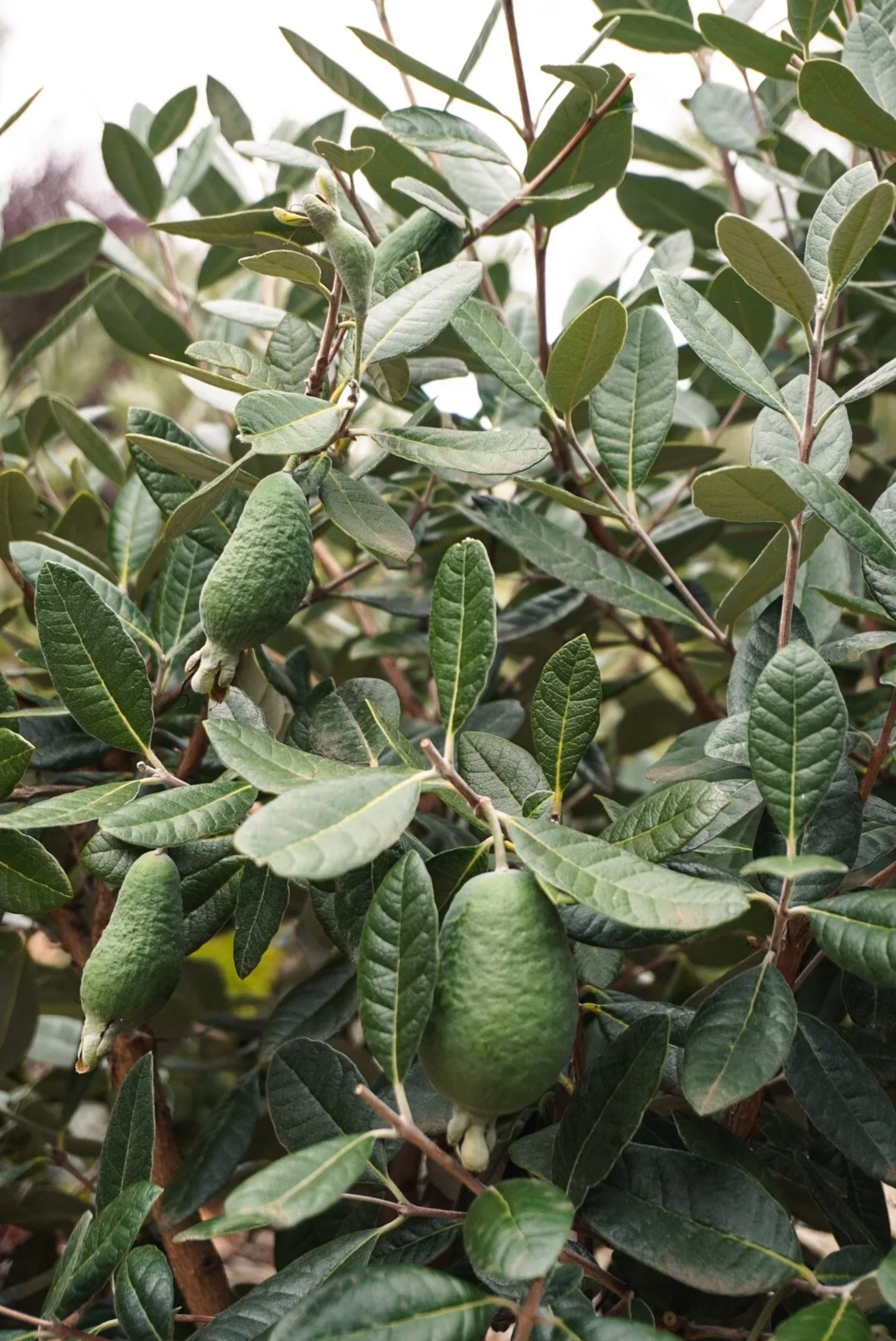
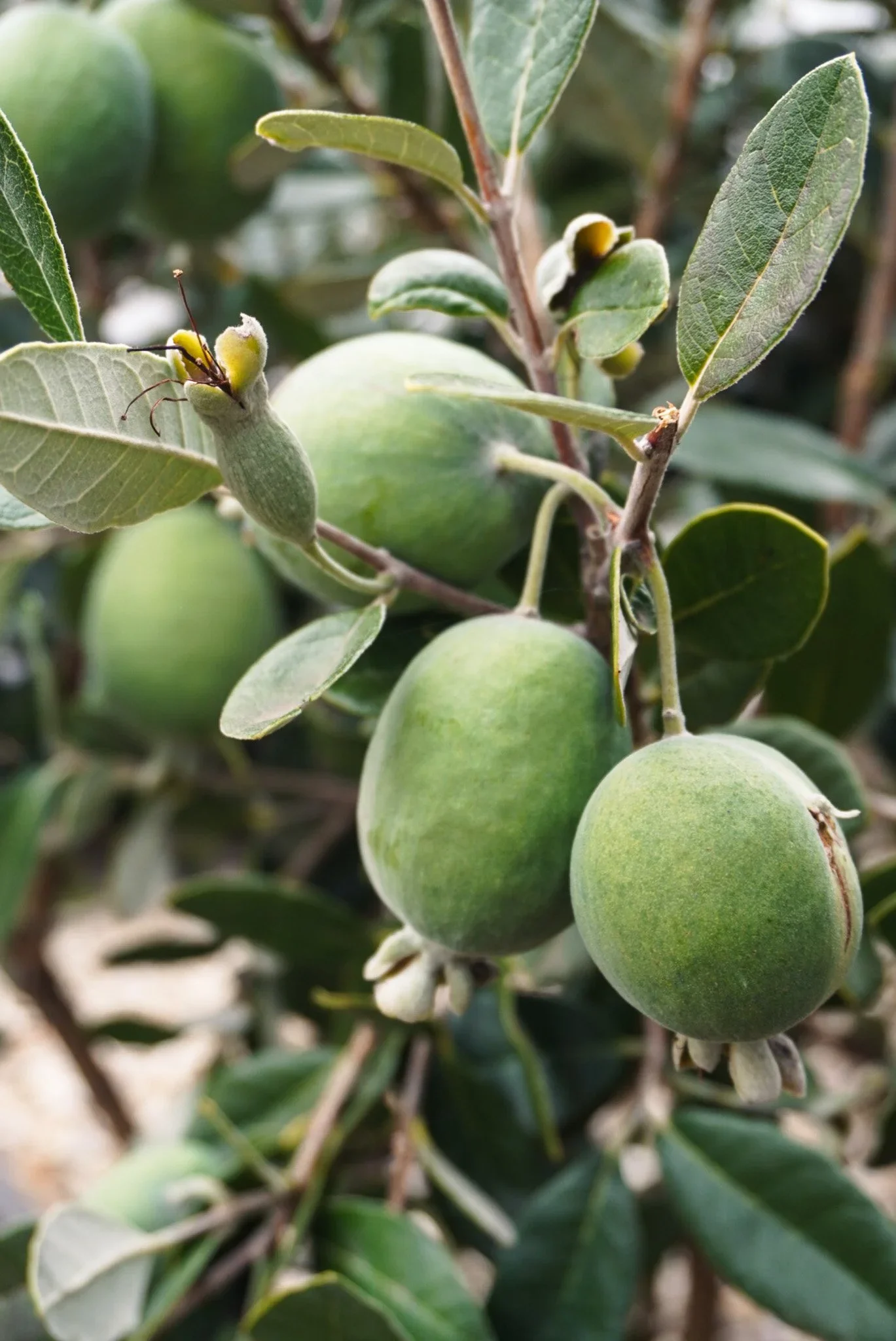
I smell them before I see them. I'll be walking the front of the garden on some errand that has nothing to do with fruit, and there it is — that perfume coming up off the gravel. Pineapple, guava, something floral underneath, a sherbet edge to it. I stop. I look down. And there, half-tucked under the foliage or sitting in the stones where they've fallen, are the feijoas. Plain green. Easy to miss entirely if your nose hadn't already told you they were there.
I still find it astonishing that a fruit so unremarkable to look at gives itself away by scent alone.
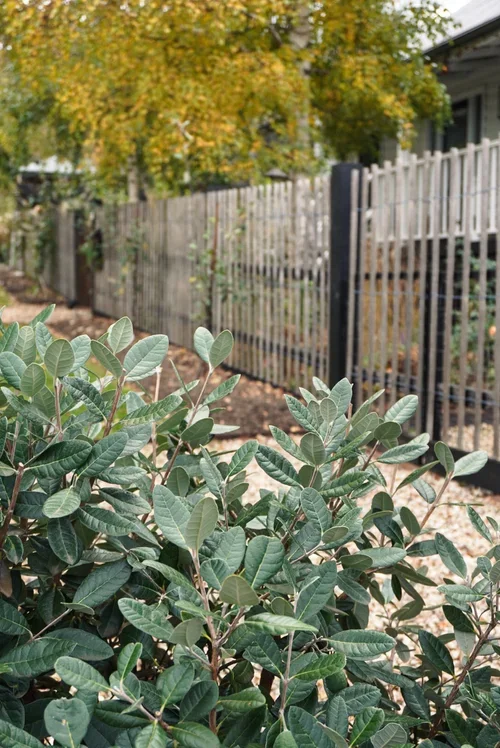
When I wrote about this hedge last year, the plants were barely a metre high and had only just begun to fruit. It was thrilling, and it was mostly promise. I'd put them in for fruit, yes, but also for structure, and for the privacy of a living screen that would, in time, soften the neighbouring rooftops that sit between me and the hills.
A year on, the rooftops are still there. Slightly less of them. The hedge hasn't reached its height — I didn't expect it to in a single year — and it hasn't yet done the screening job I planted it to do. But it has thickened and settled, and it has begun to behave like a part of the garden with something to do, rather than a row of new plants hoping to make it. And this year it has fruited properly.
That's where the satisfaction actually sits for me. Not in the finished picture — gardens rarely hand us that on our own timetable — but in the evidence that the thing is working. The roots have taken. The plants have read the place. A decision I made a couple of seasons ago has started to give something back.
Why a hedge, and why feijoas
At Little Cottage on a Hill, every plant has to earn its keep. That doesn't mean it has to be edible. It means it has to contribute. A plant might hold structure through winter, feed the bees, soften a fence, throw a little shade, carry scent, frame a view, or simply pull me out the back door in the morning. The ones I value most do several of those things at once.
Feijoas are exactly that kind of plant.
Pineapple guava, to use the other name — an evergreen shrub or small tree with thick, silver-green leaves, edible flowers, and that fragrant autumn fruit. You can grow a single specimen happily enough. For my block, a hedge made far more sense. I wanted a boundary that worked: something to hold the edge, screen the roofline over time, and still feed me. In a small garden I come back to this logic constantly. A hedge can also fruit. A windbreak can feed you. The plant that gives you privacy can also become part of what's happening in the kitchen.
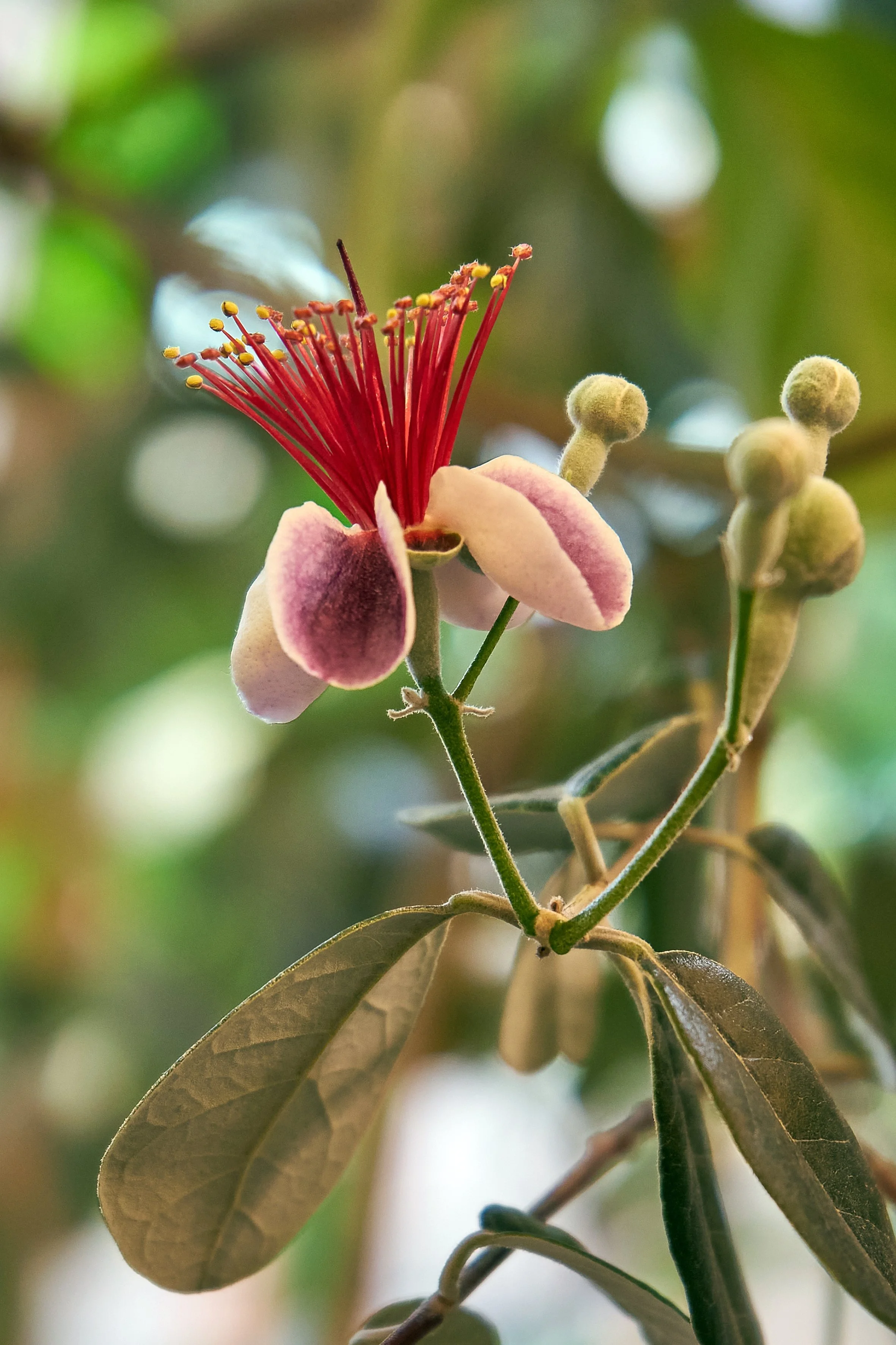
They aren't flashy. They ask very little. For most of the year they sit in the background holding their shape, and then in spring the flowers come — fleshy, sweet-petalled — and at the cold end of autumn, when much of the productive garden is winding down, the fruit begins to drop.
A fruit for the edge of winter
The timing is a large part of why I love them.
In a cool-climate garden, by the time feijoas ripen the berries are long gone, the stone fruit finished, the apples and pears winding down. The garden is moving into its quieter rhythm. And then the feijoas start to fall. They stretch the productive season out at exactly the point it can begin to feel as though the garden is closing in for the year. There's still fruit to gather. Still scent in the kitchen. Still something to scoop straight from the skin, or stew, or put away for later.
That last generous offering, right before the deeper work of winter begins, matters more than it might sound.
Feijoa blossoms.
A year on
This year the hedge has really started to give.
Not the way an old, established feijoa gives, where the fruit carpets the ground and you stand there wondering how you'll ever use it all. Mine is young. But against last year the shift is unmistakable — more fruit, more often, and more of those moments of bending down as I pass and coming up with a handful.
It still stops me. I think that's the part I love most about growing food at home — the way it punctuates a day. You're on your way to do something else, you glance down, and the garden has interrupted you. Gently. Asking you to notice.
The feijoas aren't doing everything I planted them for. The neighbours are still in view. The screen isn't there yet. But the fruit is the reminder that a garden doesn't have to be finished before it starts to give. We plant for a future we can't quite see, and we're fed along the way.
How to grow feijoas well
Feijoas get called easygoing, and they mostly are. Easygoing isn't the same as ignore-them-entirely, though. Like any fruiting plant, they reward thoughtful establishment, a bit of watching, and some seasonal care.
Plant more than one. Some varieties are self-fertile; many crop better with a partner for cross-pollination. In a home garden, more than one variety is the safer bet if it's fruit you're after rather than foliage. I planted mine as a row, which gives me the hedge and improves pollination at once. One plant can be useful. A repeated line of them becomes structure.
Give them light. Feijoas will tolerate some part shade, but they want sun, and for fruit I'd give them all the light the site allows. They want drainage too. They're tough, but they don't want wet feet. In heavier ground I plant them slightly proud of the surface and work in compost; on dry or exposed sites, mulch well and keep the water up while they establish. At Little Cottage the hedge sits where it can be both useful and seen — I don't like hiding the productive parts of a garden away.
Plant at the right time. For much of Australia, March to May is the window. Autumn planting lets the roots settle before the spring push, while there's still some warmth in the soil. In genuinely cold or frost-prone pockets I'd be more careful — young plants may want protection through their first winter, or you might wait for the soil to warm again in spring. Read your own site before anything else.
Water while they settle in. Established, they're resilient. Young, they still need you — deep watering through dry spells, especially as the fruit forms. I don't drown them and I don't forget them, and in a hedge that's worth saying twice, because closely planted shrubs end up competing with one another. A good mulch layer does an enormous amount of the work.
Prune with restraint. The temptation with a hedge is to shear it into a wall, but hard pruning costs you flowers and fruit, so I keep a light hand. I want density without stiffness — thickening and screening, but with light and movement still coming through. After fruiting I take out anything dead, crossing or awkward, and lightly shape where it's needed. In a cold area I'd hold off until the worst frosts have passed.
Let the fruit fall. This is one of the loveliest things about them. You don't tug, you don't guess. When they're ripe, they drop — that's the cue. I collect off the ground daily once they start. A ripe one has the strong perfume and a slight give: not squashy, just yielding. They bruise easily and they don't keep, so this isn't fruit to leave sitting in a bowl for a week.
Taste the flowers — gently. The petals are edible, sweet and soft, with that sherbet quality that's hard to resist while you're still waiting on the fruit. But no flowers, no fruit. So I taste a few and leave the rest to the bees. That's the constant negotiation in a productive garden: take what's offered, but not in a way that stops the next offering.
Making the most of the harvest
I still love them fresh — halved, scooped with a teaspoon, standing in the kitchen or out in the garden.
But roasting them changed how I think about the fruit entirely. The first time I had roasted feijoa was in a galette from Two Fold Bakehouse here in Daylesford, paired with apple and folded into sourdough pastry. Something shifted. The sharp, perfumed thing I knew turned soft and deep and almost spiced. I've been far more interested in cooking them ever since.
They stew beautifully, spooned over porridge or yoghurt or cake. They go into crumbles with apple. They make good jam, especially with ginger or fig or lemon. And they take well to preserving — bottled, fermented, folded into syrups and shrubs, where that floral perfume can be carried well past the short window it's actually here.
Because that's the thing with feijoas. The season is generous and brief. Once they begin to fall you have to keep up. Some get eaten where I stand, some go over the fence to neighbours, some sit scenting the kitchen for a day. But when the fruit really arrives, preserving stops being a romantic idea and becomes a practical rhythm — a way of carrying a short season forward into the cold months. A glut in May becoming syrup in July. That's the right kind of abundance, to my mind.
Would I do it again
Without hesitation. I'd probably plant more.
Every feijoa I find on the gravel reminds me why they went in: for the fruit, but also for the shape the garden is still growing into, for the privacy I'm waiting on, for the way a small block can hold so much more than seems possible when every plant is asked to pull its weight. One day I hope the hedge meets the horizon and the rooftops vanish behind the silver-green. For now, I'll take the fruit.
And if you're thinking about your own front garden, a boundary, or a verge, the feijoa is a good example of one plant doing several jobs at once — screening, flowering, fruiting, feeding pollinators, softening a street edge, and stretching the season into the start of winter.
Not every verge will suit one, mind. Council guidelines, sightlines, services, the path, car doors, the mature height of the plant — all of it matters. But where there's room and your local rules allow, productive screening is a clever and generous way to make a public edge work harder.
That's exactly the kind of thinking I get into in my newest free ebook, Nature Strip Gardens: Fundamentals for Beautiful, Compliant Verges — a practical guide to reading your site, working with your council's guidelines, building better verge soil, choosing plants with care, and making a strip of ground that's beautiful, safe, useful and generous to the street.
Download it, share it, and start with the ground you already have.
Thanks so much for following along.
Natasha xx
Continue your gardening journey with me
If you enjoy this kind of content, my workshops offer more detail and guidance on design, productivity and seasonal care.
If you are building your garden from home right now, my e-books on Wicking Bed Gardens, Introduction to Backyard Chicken Keeping and Compost for Beautiful Productive Gardens offer practical step by step guidance that pairs well with the workshops
I share seasonal tips, behind the scenes at Little Cottage on a Hill, and new resources through my newsletter. Subscribe to receive my entire plant list from the garden as a personal thank you.
You can also pre-order my book The Productive Garden Companion, the book I have wanted to find my entire life. A complete guide to growing for abundance and beauty in any space. The Productive Garden Companion is a practical, reassuring and visually rich modern gardening book that meets gardeners wherever they are, from windowsill pots to generous acreage.
You may want to check out my related content below:
June Garden Tasks - For Australian Climates
Landscape Lingo - The ‘Chelsea Chop’ and Ways to Have Plants Look Their Best
No Dig Gardening - Less Work, Healthier Soil
Stay connected for more seasonal inspiration:
Instagram | Facebook | Gardenstead | LinkedIn | Pinterest | YouTube | Website | Newsletter
Thanks so much for following along.
Natasha xx

Feijoas: A Hedge That Earns Its Keep
I can’t tell you how thrilled I was when I saw the first feijoas on the ground this week. Just a few, nestled into the gravel under my hedge. But that’s how you know—they fall when they’re ready. No guesswork. No squeezing or poking. Just a gentle drop and the most incredible scent wafting up when you lean in close.
This hedge of mine was planted about a year and a half ago—still only around a metre high—but it’s already started producing. Here, everything in the garden has to work hard, even the hedges. So when one starts gifting much-anticipated fruit like this, it literally stops me in my tracks.
It’s not just a productive hedge either—it’s one of the many design devices at work in my small garden. Eventually, when it reaches around 2 metres tall, it will do what I planted it to do: screen out the neighbouring rooftops that currently interrupt my line of sight to Daylesford’s rolling hills. That’s the goal. A living screen that brings fruit, privacy, softness, and structure all at once.
Even though I live right in town on a small block, this hedge will eventually create the ‘illusion’ that I’m tucked away in the country. That moment—afternoons on the verandah, cuppa in hand, hills stretching out beyond, and little-to-no sight of neighbouring rooftops—feels just within reach now. It’s these layered, multifunctional elements that I think make a garden sing.
I’ve always loved feijoas, eaten fresh, cut in half with the pulp scooped out with a spoon, but the turning point was a galette from Two Fold Bakehouse. I’ll never forget it. Roasted feijoas, still in their skins, paired with apple and wrapped in Alison’s sourdough pastry. It absolutely blew me away. I hadn’t tasted feijoas like that before—soft, perfumed, almost spiced without anything added. I literally haven’t stopped thinking about it since.
What Makes a Feijoa Worth Growing?
Feijoas are one of those trees that quietly pull their weight. Evergreen, drought-tolerant once established, fire-retardant (which matters out here), and fruiting at the tail-end of the season—just when the apples are finishing and the garden starts to exhale.
I first came across the idea of a ‘fedge’—a feijoa hedge—through the team at Milkwood. It stuck with me. The practicality of it. A windbreak that feeds you. Shelter for a veggie patch or a chicken run. Pollination support if you plant a few different varieties close together. And that slow daily shuffle when the fruit starts dropping—bending down, collecting them one by one. It’s the sort of rhythm I love.
They’re slow to start, but once they do, they don’t muck around. As Milkwood puts it: “When feijoas fruit, they really, really fruit.” You’ll have more than enough for fresh eating, sharing, and preserving.
A Few Tips From the Patch
Planting: If you’ve got room, plant more than one. Some are self-pollinating, but many need a mate to produce well. I have 7 in a row.
Spacing: 1.5 metres apart is ideal for a fedge. I was impatient and planted thema little closer for faster ‘filling-out’.
Flowering: The petals are edible—sweet and sherbet-like. We always try a few at the very start of the season in anticipation of what’s to come, but go easy if you want a proper fruit set - no flowers, means no fruit!
Harvesting: Don’t tug them off the tree. If they’re ready, they’ll fall. That’s your cue.
And if you’re wondering what to do with a glut—don’t peel them. Trust me. And trust Milkwood. Roast or stew them skins-on, jam them with fig and ginger, or try your hand at a fermented soda, syrup or shrub.
For the Love of Feijoas
There’s something about them that feels old-world and underappreciated. I’m always amazed how many people don’t know what they are. Or worse—grow them for hedging and don’t pick the fruit. It’s a quiet sort of abundance. The sort that asks for a bit of observation. A bit of seasonal noticing. Which suits me just fine.
Would I plant a feijoa hedge again? Absolutely. It’s not just about the fruit—it’s the feeling of walking out into the garden, finding something unexpected, and being reminded why you planted it in the first place. And for me, it’s also the promise of those uninterrupted views—when the feijoas finally meet the horizon and I feel like it’s just me and the hills.
And if anyone reading this has a galette-worthy feijoa recipe—or another way to roast them whole—I’d love to hear it.
Local Love: Two Fold Bakehouse
The galette that made me fall in love with roasted feijoas came from Two Fold Bakehouse—a small home bakery here in Daylesford that quietly does extraordinary things.
Two Fold bakes naturally leavened, organic loaves using stoneground flours and works with the seasons, letting what’s growing locally shape what’s baked. But their bread is about far more than bread—it’s about relationships. Farmers in wheat fields, millers milling, bakers folding, and community gathering. Their commitment to regenerative agriculture and a local grain economy is felt in every bite. I feel fortunate that I can call the super humble sourdough baker extraordinaire, Allison, a dear friend.
You can buy their bread via:
Thursday Bread (weekly) – order online for pick-up in Daylesford, Yandoit or Kyneton
Daylesford Sunday Railway Market – every second Sunday
Hepburn Wholefoods Collective – fresh loaves every Thursday from 3pm
Join her mailing list – to find her latest news and wholewheat sourdough baking workshops
I love what she stands for—and I’m endlessly inspired by what Allison creates.
Further Reading
I highly recommend Milkwood’s guide to feijoas—practical, generous, and full of the good kind of seasonal wisdom.
You may want to check out my related content below:
From Fumigation to Flavour: What Happens to Imported Garlic Before It Reaches You – Explore the journey of garlic before it makes it to your kitchen in this insightful blog post.
Fermenting Garlic: A Recipe for Resilience – Learn how fermenting garlic can enhance its flavour and shelf life, while building resilience in your kitchen.
Enjoyed this blog?
→ Share this blog with your friends and gardening allies to spread the love and knowledge.
→ Sign up for the newsletter to stay up-to-date on upcoming workshops, garden tips, and exclusive updates from Little Cottage on a Hill.
Thanks so much for following along,
Natasha xx
For glimpses into workshops, daily life, and my thoughts from Little Cottage on a Hill, you can find me on Instagram, Facebook, LinkedIn, and YouTube. And if you’d like a more personal update, subscribe to my Newsletter for a monthly note on what’s growing, what’s inspiring me, and what’s next.
Click the links below to stay connected—I’d love to have you along for the journey.
The Beauty of Diverse Productive Gardens: Finding Inspiration in Every Space
The morning light streams through the summer haze as I sit here, tea in hand, watching the bees buzz between the flowering herbs and vegetables. The garden is approaching its most abundant time now, with tomatoes ripening on their vines and zucchini seemingly doubling in size overnight. From a life of making productive gardens and my transition between Oak & Monkey Puzzle's sprawling 5 acres to Little Cottage on a Hill's intimate 515m², I've learnt that productive gardens come in all shapes and sizes, each with their own unique story to tell.
Nature has a way of teaching us that there's no one-size-fits-all approach to creating a productive garden. Each space holds its own magic, whether it's a tiny urban courtyard or a sprawling rural property. The potential for abundance is always there, if we learn to work with what we have - especially when the earth feels warm beneath our feet and the air is thick with the scent of ripening tomatoes.
Today, I want to share a round-up of inspiring productive gardens that form part of a ridiculously large collection of images in my Pinterest library (I am a serial collector of 'precedent images'). Each demonstrates the myriad of ways productive gardens can be designed and implemented and that with abundance there can be great beauty whilst meeting the needs of each context.
The Layered Garden
There's something magical about a garden that grows up as well as out. I love how climbing beans create living walls, their flowers drawing in buzzing bees while their leaves cast dancing shadows on the plants below. At Little Cottage on a Hill, these vertical spaces have become some of our most precious growing areas. On hot summer days, the layers of green create cool, sheltered spots where tender lettuces can thrive even as the temperature soars.
The Urban Oasis
It fills me with joy to see how creative gardeners become when space is limited. Some of the most inspiring productive gardens I've seen are tucked into the smallest corners of city life. Pots overflow with herbs, vertical walls burst with strawberries, and clever trellises transform bare walls into green havens. These spaces remind me that gardening isn't about the size of your plot - it's about working with what you have and finding beauty in the possibilities.
The Traditional Kitchen Garden
Perhaps it's the rhythm of repeated plantings or the satisfaction of neat rows bursting with life, but there's something deeply grounding about a traditional kitchen garden. Right now, ours is a symphony of summer abundance - tomatoes reaching for the sky, basil perfuming the air, and zucchini flowers opening to greet the morning sun. Between these ordered rows, nature adds her own touch - self-seeded flowers pop up in unexpected places, creating moments of surprise and delight.
The Orchard Garden
Orchards are, for me, special landscape spaces. At Oak & Monkey Puzzle, the fruit trees created their own rhythm through the seasons, from spring blossoms to summer's abundance. The skills I learnt in trying out espaliering was a particular joy - watching fruit trees trained along wires transform a simple fence line into a productive, living wall. Now at Little Cottage on a Hill, we're creating our own espalier orchard along the north-facing fenceline, proving that even in a small space, we can work with nature to create beautiful, productive boundaries. On hot summer days, I'm especially grateful for the dappled shade fruit trees cast, creating perfect spots for both plants and people to gather.
Lessons from an Ever-Evolving Garden
What I've learnt through my own journey is that productive gardens are truly "open works" - they're never finished, always evolving through seasons and years. Right now, they're teaching me about resilience, about adapting to heat and how to preserve precious water while still creating abundance. This is my driest summer in years, and now, being located in Daylesford, I’m learning about what that means in this location.
Growing Through Change: Productive Gardening for Every Space
As we continue to adapt to our changing climate and smaller spaces, these diverse approaches to productive gardening become increasingly valuable. They show us that whether we have acres or square metres, there's always room to grow, to learn, and to create beauty - even in the challenges of an Australian summer.
Want to learn more about creating your own productive garden? Join me for my upcoming workshop: Workshop with Natasha Morgan. Together, we'll explore how to transform your space, whatever its size, into a thriving productive garden that reflects your unique vision of living well.
I'd love to hear about your favourite productive gardens. What style speaks to you? Share your faves in the comments below —- It’s so good to know from others what inspires them too.