
• About
  • Shop
  • Preserve
  • Blog
  • Contact
  • The Book
  • Cultivate
  • Forage
  • Menu

Natasha Morgan

  • About
  • Shop
  • Preserve
  • Blog
  • Contact
  • The Book
  • Cultivate
  • Forage

Designing Gardens for All Seasons

December 16, 2024

Designing Gardens for Every Season: A Personal Reflection

Gardens, like the landscapes they inhabit, are storytellers. With every turn of the season, they whisper tales of change, resilience, and quiet beauty. From the tender green shoots of spring to summer’s exuberant crescendo, the muted richness of autumn, and the stark, sculptural lines of winter, a garden evolves—a narrative in motion.

At Little Cottage on a Hill, I’ve come to cherish this seasonal rhythm, weaving it into the very fabric of my garden’s design. Each element has a purpose, a role to play across the year, ensuring the space feels alive and beautiful, no matter the time.

Here’s how I approach designing gardens for all seasons, where structure and plant selection work in symbiosis to create a landscape that feels timeless and ever-changing.
The Backbone of the Garden: Structure Across Seasons

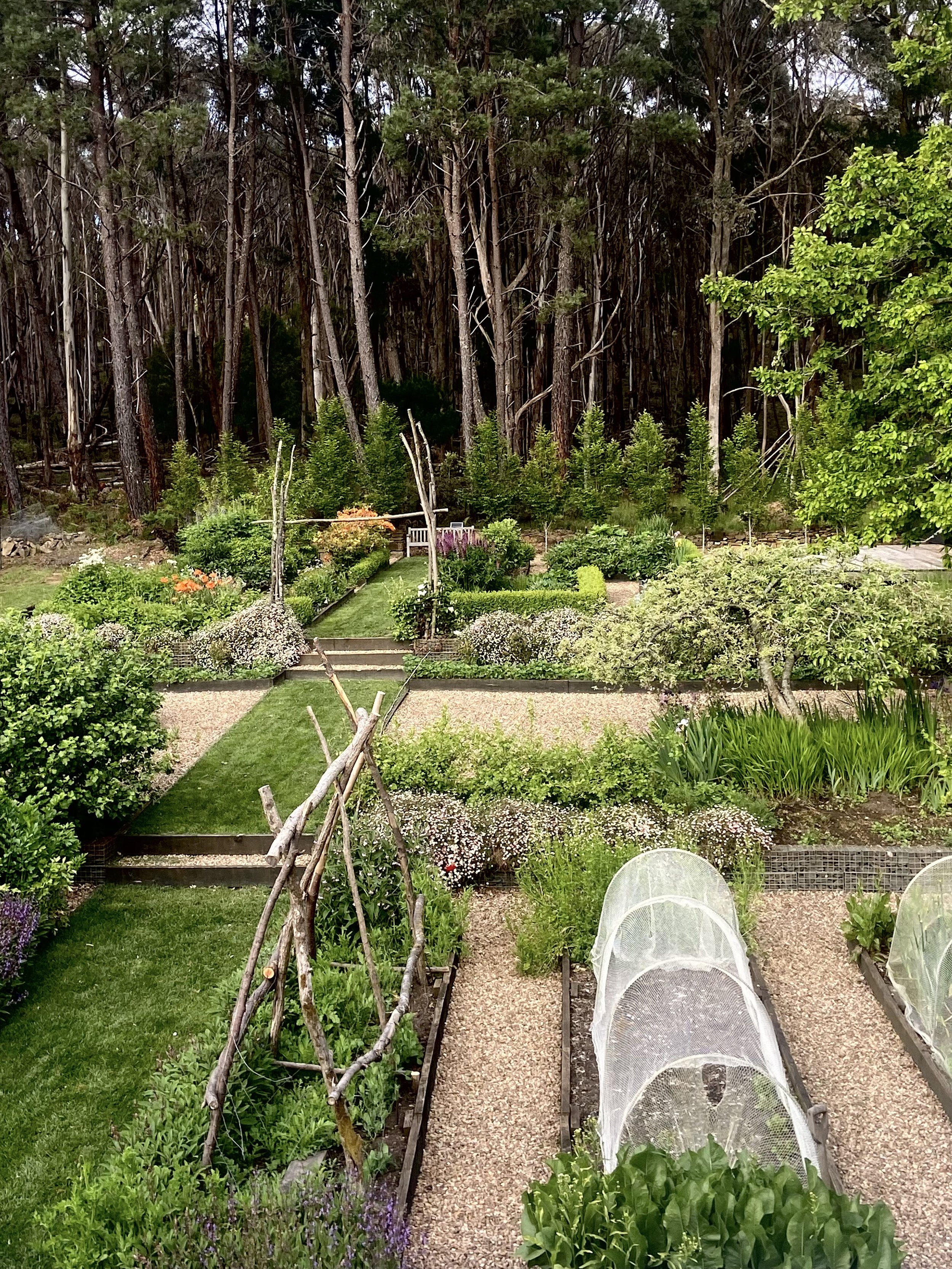
When blossoms fade and foliage retreats, structure is what remains. It’s the backbone of a garden, holding everything together through the quiet months. In my garden, clipped spheres of Buxus provide a thread of continuity, their evergreen forms anchoring each space with a quiet elegance. These sculptural shapes endure through every season, offering a constant amidst nature’s ebb and flow.

Hedges, too, play an invaluable role. Whether it’s the glossy green of Portuguese laurel or the steadfast presence of yew, hedges create enclosures, guide the eye, and bring a sense of rhythm to the garden. They’re living architecture—soft yet strong, functional yet beautiful.

Paths and walls add another layer of structure. Gravel pathways curve through planting beds, inviting exploration, while stone walls weather with age, their textures deepening the garden’s story. Even vertical trellises lend height and a touch of whimsy, transforming bare walls into canvases for climbers that change with the seasons.

947D7381-C0A4-4C01-8953-47A63BD9711B.JPG
Natasha Morgan-EWeaving-May2024-166A8456.jpg
Natasha Morgan-EWeaving-May2024-166A8454.jpg
Natasha Morgan-EWeaving-Jul2023-166A0497.jpg

Plants That Earn Their Place

In a smaller garden, every plant must pull its weight. There’s little room for those that offer only fleeting moments of beauty. Instead, I seek out plants that contribute across multiple seasons—plants that evolve with time, revealing new facets as the year unfolds.

  • Hydrangea Paniculata: Summer sees its conical blooms in full glory, but even as they fade, their papery forms bring a delicate beauty to winter’s starkness.

  • Echinacea: Bright, pollinator-friendly flowers in summer give way to seed heads that stand tall in autumn and catch the frost’s sparkle in winter.

  • Miscanthus: Ornamental grasses like this bring movement and texture. Their golden tones in winter soften the garden’s edges, a reminder of warmth even in the coldest months.

  • Cornus alba (red-stemmed dogwood): It’s in the depth of winter that this plant truly shines, its vivid red stems a striking contrast against muted backdrops.

These are the quiet achievers of the garden, their beauty unfurling with the seasons, always offering something new.

Celebrating Seasonality in Design

Garden designers like Piet Oudolf have shown us how to embrace seasonality with grace and creativity. His planting designs, characterised by drifts of perennials and grasses, are a masterclass in letting plants express their full life cycles—from their exuberant peak to their quiet decline. Oudolf’s gardens, such as the High Line in New York, demonstrate the power of seed heads, faded flowers, and winter stems to carry a garden through its quieter months.

Other designers who excel in creating year-round interest include:

• Dan Pearson: His work often feels like a conversation with the landscape, integrating naturalistic planting with a sensitivity to structure. His Millennium Forest project in Japan is a stunning example of how structure and planting create a narrative across the seasons.

• Nigel Dunnett: Known for his innovative approach to sustainable planting, Dunnett’s schemes use perennials, annuals, and grasses to create dynamic, seasonally evolving gardens, such as the Olympic Park in London.

• Arne Maynard: His formal gardens often combine traditional clipped shapes with naturalistic planting. The juxtaposition of structure and wildness creates an ever-evolving interplay between control and spontaneity.

• Sarah Price: With an emphasis on texture, light, and movement, her designs celebrate the changing seasons, often drawing on natural landscapes for inspiration.

DSC06403.jpg
DSC06897.jpg
DSC01412.jpg

Designing for Small Spaces

In my own garden at Little Cottage On A Hill, every element has to work hard. Plants that offer a singular moment of beauty—a “one-hit wonder”—simply don’t have a place. By combining structure with hardworking plants and designing with the seasons in mind, even the smallest garden can feel expansive and dynamic.

Think about layering: the interplay of bulbs in spring, perennials in summer, and seed heads in autumn, all underpinned by structural elements like clipped shrubs or a carefully placed trellis. Consider planting for transitions—how does one season flow into the next? Choose plants that soften the edges and draw the eye through the space, making the garden feel larger and more unified.

Natasha Morgan-EWeaving-Jul2023-166A0454.jpg

A Reflection on the Seasons

Gardening for all seasons is, at its heart, an act of mindfulness. It’s about pausing to witness the frost glinting on a seed head, the warmth of winter stems catching the light, or the promise held in the first green shoots of spring.

By designing with structure, selecting hardworking plants, and embracing the rhythm of the seasons, we create gardens that not only endure but bring endless joy. Whether you’re working with acres of land or a tiny urban courtyard, this approach ensures your space remains alive with beauty and meaning.

As the seasons shift, so too does the garden. And in those quiet moments—when we stop to marvel at a seed head or trace the curve of a path—we find ourselves connected, not just to the earth beneath our feet but to the passage of time itself.

Here’s to designing gardens that carry us through every season, reminding us of the wonder that lies in change.

Tags: gardening, garden design, garden planning, garden design principles, regenerative gardening, garden systems
Prev / Next

Subscribe

Sign up with your email address to receive news and updates.

We respect your privacy.

Thank you!
They used to call Charles Dowding @charles_dowding the lazy gardener. He told me this from his extraordinary experimental no-dog market garden and international flagship, Homeacres in Somerset, UK, me at the kitchen table in Daylesford, Australia, in a conversation I recorded for The Productive Garden Companion. Somewhere along the way hard work became the point of gardening, and Charles has spent 40 years asking whether it has to be. Feed the soil and let the biology do the rest. It’s the same thing I’ve been trying to say about a whole garden: make one that gives more than it takes, do it thoughtfully and then consider if there’s ways you can ‘get out of its way’ to reap the rewards. That’s why the book holds whole conversations. Scan the QR code on the no-dig pages and you’re listening to Charles, unscripted, in real conversation generously and authentically shared. There are QR codes like this all through the book. Two years of work, and these are the part I’m probably proudest of - the part that takes the book beyond its pages and continues to expand with time. Books generally are capsules fixed in time. My hope is that this one shares, gives and evolves, but most importantly that it continues to walk beside you as your own garden journey grows. Charles has walked alongside me in my own growing journey over the years, providing hard won insight and inspiration. His conversation with me is an invitation for him to walk beside you too! I’m so honoured to announce that The Productive Garden Companion is out now in the UK (Murdoch Books) wherever you buy books, or via the link in my bio. Thank you so much Charles for finding your way into its pages. @murdochbooks_uk @murdochbooks #nodig #charlesdowding #theproductivegardencompanion #NatashaMorgan #ukgardening
Tonight I’ll stand in a room full of the people who have contributed to The Productive Garden Companion through its words, a life, and friendships - and hold it up this book amongst you all for the very first time.

I cannot wait  to be amongst
Tonight I’ll stand in a room full of the people who have contributed to The Productive Garden Companion through its words, a life, and friendships - and hold it up this book amongst you all for the very first time. I cannot wait to be amongst a room of the very special people who helped make this book happen. The growers, makers and thinkers whose hands are in every chapter, all in one room on one night. Friends from twenty years back. Family. And you, I hope. I keep trying to think about the words I’ll share. The beautiful faces I’ll see and what my community means to me - the bit where I say thank you out loud and I can’t get through it without emotions flooding in. I’ve just looked over the latest guest list and gosh there’s going to be some extraordinarily important people there tonight. I’d love to welcome you to that room too! Saturday’s Daylesford book launch is now sold out, so if you’ve been waiting for one of these, tonight is the first launch and there’s a handful of tickets left. Then it’s done. $15, welcome drinks and food included. Tickets: tap the link in my bio, choose ‘Natasha’s events, workshops & e-books’, then Melbourne Launch. Melbourne Book Launch Thursday 17 September 2026 5.30–7.30pm Firecracker Events 58A Victoria Rd, Northcote The biggest of big thanks to my dear friend Cassie @firecrackerevent , on this crazy journey with me since my student days in 2002, in more wonderful ways than I can count. Thank you to our incredible supporters @hepburndistillery @victorias.heartland @barry_and_co @thecottageherbalist @billypress_ @acreofroses @amber.gardener @stonewallsmusk @musklanewine @thediggersclub @gardencentresofaustralia @woodendgeneral @avenuebookstore @kateseddon_landscapedesign @mineralspringsco
If I look a bit bleary-eyed in this, it’s because of a book. There hasn’t been a lot of sleep around here lately, and all of it comes back to The Productive Garden Companion. Today is publication day. I keep trying to explain what this book is and I land in the same place every time. Yes, it’s a gardening book. It’s a book about landscape design. And underneath all of that, it’s a book about what it is to live well, and why I keep returning to the garden through every chapter of my life. In many ways it’s the culmination of fifty years of living. It’s the book I couldn’t find. A productive garden, to me, was never only about food. It’s healing. It’s solace. It’s wellbeing, community, biodiversity. It’s a garden that gives more than it takes, and that has been the ethos of this book from the very first page. I hope you find it as generous as you have been with me. Because the support has been unbelievable. Utterly phenomenal. And I truly know this book will find its way into the hands and hearts of people who perhaps didn’t even know they needed it. So this is my invitation. Wherever you are, wherever you grow, whatever your scale or your climate, a balcony with a few pots or a grand estate, this book is there to walk beside you. To inspire you, to empower you, to invite you to start where you are. Grow one thing. Even if that’s all you start with. And maybe let it ripple out. It’s out now. Online, in stores, and hopefully coming to libraries and schools near you. Find it where you find all good books. And I’m doing a massive run to the post office today to send out all of your incredible orders. Thank you. Thank you for being here. None of this happens alone. I have so much more to share. @murdochbooks #TheProductiveGardenCompanion #NatashaMorgan #MurdochBooks #GrowOneThing #GardenDesign
It is blowing a gale up here and I have come out to show you this garden one last time before it all gets cut down tomorrow. The calendar says spring. The garden says give me another few weeks. I go by what I can see, never by the date, and up here it is still wind, still cold, still last autumn lying over everything. It is all bleached and paper dry and moving about in the wind, which is exactly how I want it to look before it goes. I leave it standing all winter for that reason. The birds get the seed, the frost sits on the heads of a morning, and I get to watch the whole thing come apart slowly instead of tidying it away back in March. Tomorrow the lot comes off. We are cutting and bundling every grass and every seed head out of here, because all of it is going to become a botanical installation for the launch at @stonewallsmusk on Saturday the 19th and Sunday the 20th of September. Alissa from @larkspur_flowers__ and are going to create some magic out of it all to fill the gallery! Then when the exhibition comes down it moves on again, to the windows of @woodendgeneral , where I am doing a book signing with @thecottageherbalist and @billypress_ . That one is free but you do need to book so we know numbers. Link on my website. The orange geum stays where it is. So do the box balls, already clipped, holding the bones of the whole thing while everything else disappears. And then there is what is underneath, because under all of this last-of-autumn mess there are thousands and thousands of bulbs already up. That is deliberate. My gardens have to work hard right through the year, so the day I take this layer off, the colour is already there waiting. Structure from the box. Colour from the bulbs. I do think it is worth stopping and looking at a garden before it gets chopped. It is all the same cycle. Nothing is being lost here, it is just going somewhere else for a few weeks. Watch this space. I will take you back out tomorrow with the secateurs going. #gardendesign #gardenlife #australiangarden #LittleCottageOnAHill #TheProductiveGardenCompanion
One week. I can’t get my head around it! I never imagined what book publication day might feel like, and one week out I’m just starting to get a glimpse. Reflective, a little emotional, totally overwhelmed. A whole program of launch events kicks off next week: the Melbourne launch at @firecrackerevent on Thursday 17 September, then the exhibition and book launch at @stonewallsmusk in Musk on Saturday 19 September. But I didn’t start life as a country dweller. I started as a landscape architect with a whole lot of ideas and a whole lot of aspirations. An architecture degree, then landscape architecture, and 15 years working on public realm projects like the Australian Garden at Royal Botanic Gardens Cranbourne. I lectured for 10+ years across RMIT and Melbourne universities. Then I found a country property that was only ever supposed to be a weekender. Meg Travis @girlfridays_notes , captured in my book, said that when she first came to Oak & Monkey Puzzle it was ‘the first day of forever’. It was exactly the same for me. Someone I met out of the blue the other day told me that when they drive from Melbourne to Daylesford, there’s a point on the Ballan-Daylesford Road where they feel something shift. They knew the exact spot and knew nothing about me. That exact spot was Oak & Monkey Puzzle! The threshold of a life where landscape became something I did for me, and then shared outwards. A place that nourished me in ways I could never have imagined. Then came the epiphany about soil, sky, air and water, the one that runs all through the book, and it led me here. Little Cottage on a Hill in Daylesford. Sometimes it’s nice to look back and see how far you’ve come. Here’s a little trip down memory lane. I hope you’ll celebrate with me, not just the fact that the book is so nearly here, but the whole lifetime that got me here. It’s all in the book’s pages. It’s the book I couldn’t find. Part life story, part memoir, so to speak. A lifetime of gardening, a career in design, and the stories of so many contributors from around the world, generously shared. Here’s a snippet of a life that led me here. Book events are on my website
Hi everyone, I’m in my potting shed — greenhouse-y kind of a space — watering seedlings, and all my summer things are starting to germinate. It’s just the nicest time to be in here. I’ve just come back from two beautiful days in Adelaide for the Horticultural Media Association @hmaaustralia awards (Gardenstead @gardenstead was a finalist, so I was there flying the flag). And being back in the shed got me thinking. I’m going to start sharing the nuts and bolts of what I’m doing in my garden, day to day, on my @substack. Unpolished. Unfiltered. Not that I’m ever really filtered anyway. You’ll find this on my Substack account: (@natashamorgangardens) I want this to be a really generous, authentic, raw kind of space where you can actually join me. That’s what my book is all about too — The Productive Garden Companion. It’s a companion because I want it to walk beside you in the truest sense. Something that holds your hand. Something generous and real and warm, my words on the page literally just accompanying you. So here’s the invitation: come and join me on Substack. Share what you’re doing in your garden as I share what I’m doing in mine — I’d love to see it in the comments there. One last thing — all the events for the book are on my website (link in bio), with more being added all the time. I’m so, so grateful to the bookshops, venues and partners supporting me. It’s quite phenomenal, it really is. And to everyone who pre-ordered: thank you. If you haven’t, there’s still time (link in bio) — and bring your pre-ordered book along to one of the events so I can say thank you in person and sign it for you. I hope you’re having a beautiful day. And happy Father’s Day to all the fathers out there! Natasha x #GardenWithMe #TheProductiveGardenCompanion #GardeningAustralia #PottingShed #NatashaMorgan
I am great in my own domain. The thought of being with hundreds of people from across Australia, even though united by a common love, still had me more than a little nervous, travelling to Adelaide as Gardenstead was a finalist at the HMAA Laurel Awards. But I can say, without the slightest reservation, is that in little more than 48 hours it become screamingly obvious that the gardening and horticultural industry holds some of the kindest, most generous, warm-hearted, engaging, authentic people you will ever find. From the HMAA awards held at the extraordinary estate and gardens of Carrick Hill. A room full of people I respect so greatly and deeply admire, from all over Australia. To last nights industry preview at provided a wonderful opportunity to thank Costa Georgiadis firsthand for his kindness in the words he shared about my book. I got to meet people I’ve been inspired by across an entire life. Sophie Thomson, for the very first time. Even managed to give Hannah Moloney a good squeeze. Mamma mia, she is a woman who stands tall, and not just in stature. In energy. What a powerhouse. What an absolute inspiration. Angus Stewart, a delight as always. Sharing a room with Graham Ross. Liz Wilson of Gardening Australia magazine, what an extraordinary person she is. Kind and generous, the sort of person who just makes you feel warm being near her. Connie Cao going from strength to strength. Lisa and Fiona of Diggers, laughing to tears! I have come home exhausted, but also with a heart absolutely full. It’s extraordinary to be able to look back at this community I find myself in. What a magnificent weekend with the greatest of thanks to the Horticultural Media Association of Australia. And Adelaide. What a city. So honoured and privileged to be there flying the flag for Gardenstead. A true honour to be a finalist in a room of extraordinary people. I can’t wait for the next Laurels. Two years away, and so many faces I now know that I just can’t wait to get back there. With the biggest of thanks to every single person tagged here. It was an absolute joy to meet you. X
The garden is beginning to move with the season here in Daylesford, while on the other side of the world, autumn is settling in.⁠
⁠
For the first time, my monthly garden tasks blog covers both hemispheres. What to plant, what to sow, and what to do t
The garden is beginning to move with the season here in Daylesford, while on the other side of the world, autumn is settling in.⁠ ⁠ For the first time, my monthly garden tasks blog covers both hemispheres. What to plant, what to sow, and what to do this September for the five Australian climates as I always have, and now for the Northern Hemisphere too. Over the past few months, so many more of you have been joining me from the other side of the world, and it feels like time to make what I share here work for you as well as it does for the community here at home. So welcome! I am so glad you’re here.⁠ ⁠ Here in the Central Victorian Highlands, we are still finishing winter. What locally we call ‘Sprinter’ will linger for a good few more weeks, before Spring is truly here. The wattle is gold on the roadsides. And a frost or two is still to come.⁠ ⁠ If you are in the Northern Hemisphere, September is when the set-up for next spring begins. Bulbs. Garlic. Cuttings. Seed collecting and sharing.⁠ ⁠ The full September blog is now live, with guides on what to sow and plant in September and task guides for every climate group. Find the blog on my website, link in my bio 🌿⁠ ⁠ And if you think this might help someone else too, please share it with a gardening friend on your side of the world.⁠ ⁠ ⁠ #TheProductiveGarden Companion #NatashaMorgan #GrowOneThing #SeptemberGarden #ProductiveGarden⁠
I always say my year doesn't start in January. It starts when the sap rises. And right now, you can feel it beginning, see it happening.⁠
⁠
The tête-à-têtes came up on the western verge in the last days of August, small, certain, a
I always say my year doesn't start in January. It starts when the sap rises. And right now, you can feel it beginning, see it happening.⁠ ⁠ The tête-à-têtes came up on the western verge in the last days of August, small, certain, absurdly yellow. The light lands deeper into the beds now and stays later. All winter I wrote about watching. Spring, I've come to think, is about feeling.⁠ ⁠ Though on this cool-climate hill it isn't truly spring yet. Frost keeps visiting until late October, maybe even later, so what comes first is the in-between I like to call 'sprinter'. We'll have two warm days that convince you is Spring is here, then a morning that bites. One step forward, two back.⁠ ⁠ I've written a reflection on this inbetween season on the blog. Where the word flora actually comes from, the roses on the fence that refused to sleep this winter, and the one thing the season is asking of me now: tending.⁠ ⁠ Fifteen days from today, The Productive Garden Companion, a book I've spent two years growing, goes out into the world. My own small becoming. Sap rising in another form.⁠ ⁠ Read the full piece on the blog or Substack, link in bio 🌿⁠ ⁠ Xxx⁠ ⁠ #productivegarden #gardendesign #GrowOneThing #TheProductiveGardenCompanion #NatashaMorgan⁠