
• About
  • Shop
  • Preserve
  • Blog
  • Contact
  • The Book
  • Cultivate
  • Forage
  • Menu

Natasha Morgan

  • About
  • Shop
  • Preserve
  • Blog
  • Contact
  • The Book
  • Cultivate
  • Forage

Design Toolkit Series: Mowing as a Design Gesture

December 28, 2024

Mowing may not seem the most obvious tool in a designer’s kit, but it is one of the most immediate and powerful techniques for sculpting a space. Simple, cost-effective, and deeply responsive to the land, mowing offers an opportunity to create form and function with nothing more than a line of grass cut at a different height.

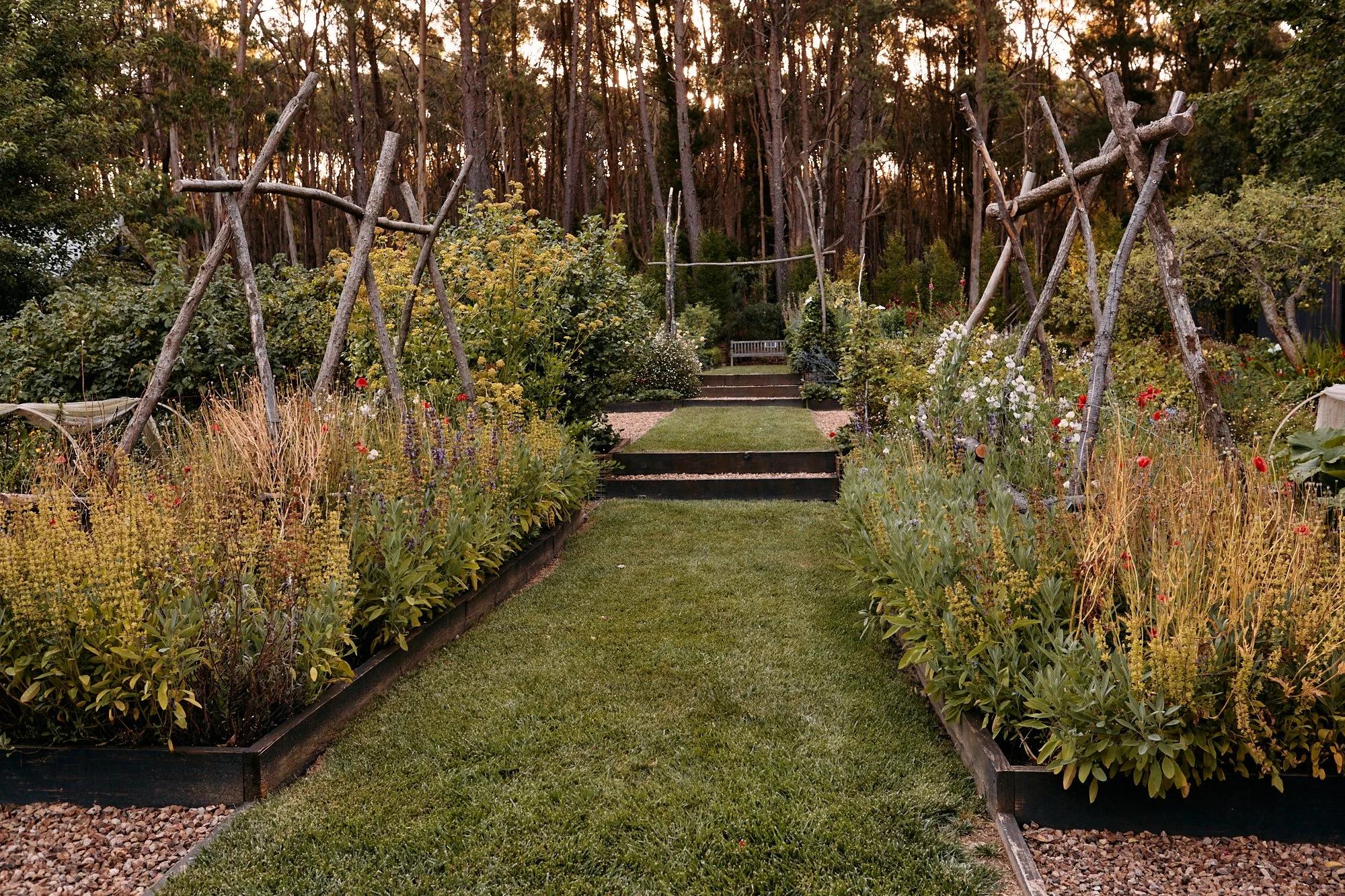
At Oak & Monkey Puzzle, mowing was a key device in my garden design. It allowed me to carve out pathways, define sightlines, and create a rhythm in the landscape that responded to the shifting light and seasons. The visual simplicity of mown paths set against swathes of wild meadows created a striking interplay of order and abundance. 

15 Natasha Morgan-EWeaving-Jan2022-75.JPG
4 DSC02000.jpg

Mowing as a Design Technique

Mowing is immediate. It offers a way to test ideas without the permanence or cost of hardscaping. With a mower in hand, you can define edges, trace pathways, and sculpt clearings—all with the quiet satisfaction of moving through the landscape in real time. The result is a beautifully functional, three-dimensional form that is both dynamic and low-maintenance.

A Quiet Caution: Sharing Spaces with Wildlife

Of course, when working with meadows and long grass, the question of snakes often arises. It’s a fair question, and one I’m always mindful of—particularly living in the Australian landscape where wildlife thrives in all its forms.

For me, inhabiting spaces is as much about being mindful as it is about design. Long grass and meadows create habitats for insects, birds, and yes, occasionally snakes. But this is their home too, and with respect and quiet caution, we can all live together.

It’s a lesson I’ve passed on to my children. I always remind them: never walk through long grass. Stick to the mown paths, where you can see clearly underfoot. This simple rule keeps us safe and allows us to move through the garden with care and awareness.

Wildlife has every right to be there—it’s a vital part of the ecosystem that makes these spaces so rich and alive. Snakes, like all creatures, tend to avoid areas of high human activity, so well-used paths and clearings naturally become safer routes. Keeping grass short in the areas where you gather or walk regularly is both practical and reassuring.

Creating Sightlines

In design, a sightline draws the eye to a focal point—be it a distant tree, a piece of architecture, or a bench that offers respite. At Oak & Monkey Puzzle, mowing became my way of choreographing a visitor’s journey. Imagine walking through waist-high meadows, the grasses swaying, with a neatly mown path underfoot. The pathway beckons, drawing the eye ahead. Beyond, a clearing emerges, framed intentionally to celebrate a view or create pause.

This approach highlights the importance of contrast—wild and clipped, light and dark, loose and precise. A mown path is as much about movement as it is about stillness.

Three-Dimensionality and Texture

Grass can be sculptural. When left to grow, it introduces height, texture, and movement. Mowing introduces a contrasting layer—one that creates depth, much like contouring on a map. Short grass becomes a ‘void’, a clearing or pathway where the land is revealed, while the taller grasses rise up as textural ‘walls’, framing these openings.

This technique is particularly impactful in smaller spaces, where every element must work harder. A single mown path through a field of wildflowers, for example, is both practical and poetic—an invitation to explore and an aesthetic gesture.

IMG_3918.JPG
1 Natasha Morgan-EWeaving-Jan2022-32.jpg

Paths, Clearings, and Alleys

Paths invite movement. Clearings create gathering spaces. Alleys frame views. All of these can be achieved through mowing. By varying the width, shape, and direction of your mown areas, you can transform the experience of a garden or meadow.

• Paths: Define a journey through your space. Think of winding paths through wildflower meadows or direct, formal lines that draw the eye to a central feature.

• Clearings: Open areas where the grass is kept short can act as rooms within the garden. Perfect for gatherings, benches, or simply moments of pause.

• Alleys: Long, straight mown strips create a sense of order and grandeur, even in an informal setting. They act as ‘hallways’, guiding visitors and creating sightlines to key features.

10 IMG_1737_cropped (1).jpg
11 DSC02144 (1).jpg

Low Cost, High Impact

One of the joys of mowing as a design tool is its accessibility. There’s no need for expensive materials or permanent structures—just a mower and a willingness to experiment. It’s a practice that aligns beautifully with my philosophy of working in symbiosis with the land. The existing grasses (‘weeds’ even!), meadows, and contours of the site are celebrated, not altered, and mowing becomes a way to highlight their beauty.

Designing with nature means embracing this balance. By observing, respecting, and gently coexisting, we can create gardens that are not only beautiful and productive but also teeming with life—just as they should be.

Bringing it to Your Garden

Whether you’re working with a sprawling meadow or a small patch of lawn, mowing offers endless possibilities:

1. Start Small: Experiment with a simple mown path through long grass. Observe how it transforms the space.

2. Embrace Contrast: Let grasses or perennials grow wild around your mown lines. The difference in texture and height will enhance the design.

3. Create Frames: Use mown clearings to create space around key features—trees, sculptures, or seating.

4. Think Temporarily: Mown lines can shift and change. Test ideas without permanence, adapting to the seasons or your mood.

DSC00857.jpg
DSC00848.jpg

A Gesture of Care

Ultimately, mowing is a gesture of care—one that acknowledges the land’s existing beauty while offering a light, considered touch. It’s a technique that is as much about restraint as it is about intervention. In this way, the act of mowing becomes a reflection of our relationship with the garden: one of observation, collaboration, and respect.

At Little Cottage on a Hill, where space is precious and every element must contribute, mowing continues to be a powerful tool for creating order, beauty, and function. It is proof that great design doesn’t need to cost the earth—it can begin with something as simple as the sweep of a mower across grass.

So, next time you take to the mower, consider it not as a chore, but as a design gesture—a way of sculpting, experimenting, and collaborating with the land, while moving through it mindfully and with care.
Tags: garden design, gardening, garden planning, garden design principles
Prev / Next

Subscribe

Sign up with your email address to receive news and updates.

We respect your privacy.

Thank you!
Tonight I’ll stand in a room full of the people who have contributed to The Productive Garden Companion through its words, a life, and friendships - and hold it up this book amongst you all for the very first time.

I cannot wait  to be amongst
Tonight I’ll stand in a room full of the people who have contributed to The Productive Garden Companion through its words, a life, and friendships - and hold it up this book amongst you all for the very first time. I cannot wait to be amongst a room of the very special people who helped make this book happen. The growers, makers and thinkers whose hands are in every chapter, all in one room on one night. Friends from twenty years back. Family. And you, I hope. I keep trying to think about the words I’ll share. The beautiful faces I’ll see and what my community means to me - the bit where I say thank you out loud and I can’t get through it without emotions flooding in. I’ve just looked over the latest guest list and gosh there’s going to be some extraordinarily important people there tonight. I’d love to welcome you to that room too! Saturday’s Daylesford book launch is now sold out, so if you’ve been waiting for one of these, tonight is the first launch and there’s a handful of tickets left. Then it’s done. $15, welcome drinks and food included. Tickets: tap the link in my bio, choose ‘Natasha’s events, workshops & e-books’, then Melbourne Launch. Melbourne Book Launch Thursday 17 September 2026 5.30–7.30pm Firecracker Events 58A Victoria Rd, Northcote The biggest of big thanks to my dear friend Cassie @firecrackerevent , on this crazy journey with me since my student days in 2002, in more wonderful ways than I can count. Thank you to our incredible supporters @hepburndistillery @victorias.heartland @barry_and_co @thecottageherbalist @billypress_ @acreofroses @amber.gardener @stonewallsmusk @musklanewine @thediggersclub @gardencentresofaustralia @woodendgeneral @avenuebookstore @kateseddon_landscapedesign @mineralspringsco
If I look a bit bleary-eyed in this, it’s because of a book. There hasn’t been a lot of sleep around here lately, and all of it comes back to The Productive Garden Companion. Today is publication day. I keep trying to explain what this book is and I land in the same place every time. Yes, it’s a gardening book. It’s a book about landscape design. And underneath all of that, it’s a book about what it is to live well, and why I keep returning to the garden through every chapter of my life. In many ways it’s the culmination of fifty years of living. It’s the book I couldn’t find. A productive garden, to me, was never only about food. It’s healing. It’s solace. It’s wellbeing, community, biodiversity. It’s a garden that gives more than it takes, and that has been the ethos of this book from the very first page. I hope you find it as generous as you have been with me. Because the support has been unbelievable. Utterly phenomenal. And I truly know this book will find its way into the hands and hearts of people who perhaps didn’t even know they needed it. So this is my invitation. Wherever you are, wherever you grow, whatever your scale or your climate, a balcony with a few pots or a grand estate, this book is there to walk beside you. To inspire you, to empower you, to invite you to start where you are. Grow one thing. Even if that’s all you start with. And maybe let it ripple out. It’s out now. Online, in stores, and hopefully coming to libraries and schools near you. Find it where you find all good books. And I’m doing a massive run to the post office today to send out all of your incredible orders. Thank you. Thank you for being here. None of this happens alone. I have so much more to share. @murdochbooks #TheProductiveGardenCompanion #NatashaMorgan #MurdochBooks #GrowOneThing #GardenDesign
It is blowing a gale up here and I have come out to show you this garden one last time before it all gets cut down tomorrow. The calendar says spring. The garden says give me another few weeks. I go by what I can see, never by the date, and up here it is still wind, still cold, still last autumn lying over everything. It is all bleached and paper dry and moving about in the wind, which is exactly how I want it to look before it goes. I leave it standing all winter for that reason. The birds get the seed, the frost sits on the heads of a morning, and I get to watch the whole thing come apart slowly instead of tidying it away back in March. Tomorrow the lot comes off. We are cutting and bundling every grass and every seed head out of here, because all of it is going to become a botanical installation for the launch at @stonewallsmusk on Saturday the 19th and Sunday the 20th of September. Alissa from @larkspur_flowers__ and are going to create some magic out of it all to fill the gallery! Then when the exhibition comes down it moves on again, to the windows of @woodendgeneral , where I am doing a book signing with @thecottageherbalist and @billypress_ . That one is free but you do need to book so we know numbers. Link on my website. The orange geum stays where it is. So do the box balls, already clipped, holding the bones of the whole thing while everything else disappears. And then there is what is underneath, because under all of this last-of-autumn mess there are thousands and thousands of bulbs already up. That is deliberate. My gardens have to work hard right through the year, so the day I take this layer off, the colour is already there waiting. Structure from the box. Colour from the bulbs. I do think it is worth stopping and looking at a garden before it gets chopped. It is all the same cycle. Nothing is being lost here, it is just going somewhere else for a few weeks. Watch this space. I will take you back out tomorrow with the secateurs going. #gardendesign #gardenlife #australiangarden #LittleCottageOnAHill #TheProductiveGardenCompanion
One week. I can’t get my head around it! I never imagined what book publication day might feel like, and one week out I’m just starting to get a glimpse. Reflective, a little emotional, totally overwhelmed. A whole program of launch events kicks off next week: the Melbourne launch at @firecrackerevent on Thursday 17 September, then the exhibition and book launch at @stonewallsmusk in Musk on Saturday 19 September. But I didn’t start life as a country dweller. I started as a landscape architect with a whole lot of ideas and a whole lot of aspirations. An architecture degree, then landscape architecture, and 15 years working on public realm projects like the Australian Garden at Royal Botanic Gardens Cranbourne. I lectured for 10+ years across RMIT and Melbourne universities. Then I found a country property that was only ever supposed to be a weekender. Meg Travis @girlfridays_notes , captured in my book, said that when she first came to Oak & Monkey Puzzle it was ‘the first day of forever’. It was exactly the same for me. Someone I met out of the blue the other day told me that when they drive from Melbourne to Daylesford, there’s a point on the Ballan-Daylesford Road where they feel something shift. They knew the exact spot and knew nothing about me. That exact spot was Oak & Monkey Puzzle! The threshold of a life where landscape became something I did for me, and then shared outwards. A place that nourished me in ways I could never have imagined. Then came the epiphany about soil, sky, air and water, the one that runs all through the book, and it led me here. Little Cottage on a Hill in Daylesford. Sometimes it’s nice to look back and see how far you’ve come. Here’s a little trip down memory lane. I hope you’ll celebrate with me, not just the fact that the book is so nearly here, but the whole lifetime that got me here. It’s all in the book’s pages. It’s the book I couldn’t find. Part life story, part memoir, so to speak. A lifetime of gardening, a career in design, and the stories of so many contributors from around the world, generously shared. Here’s a snippet of a life that led me here. Book events are on my website
Hi everyone, I’m in my potting shed — greenhouse-y kind of a space — watering seedlings, and all my summer things are starting to germinate. It’s just the nicest time to be in here. I’ve just come back from two beautiful days in Adelaide for the Horticultural Media Association @hmaaustralia awards (Gardenstead @gardenstead was a finalist, so I was there flying the flag). And being back in the shed got me thinking. I’m going to start sharing the nuts and bolts of what I’m doing in my garden, day to day, on my @substack. Unpolished. Unfiltered. Not that I’m ever really filtered anyway. You’ll find this on my Substack account: (@natashamorgangardens) I want this to be a really generous, authentic, raw kind of space where you can actually join me. That’s what my book is all about too — The Productive Garden Companion. It’s a companion because I want it to walk beside you in the truest sense. Something that holds your hand. Something generous and real and warm, my words on the page literally just accompanying you. So here’s the invitation: come and join me on Substack. Share what you’re doing in your garden as I share what I’m doing in mine — I’d love to see it in the comments there. One last thing — all the events for the book are on my website (link in bio), with more being added all the time. I’m so, so grateful to the bookshops, venues and partners supporting me. It’s quite phenomenal, it really is. And to everyone who pre-ordered: thank you. If you haven’t, there’s still time (link in bio) — and bring your pre-ordered book along to one of the events so I can say thank you in person and sign it for you. I hope you’re having a beautiful day. And happy Father’s Day to all the fathers out there! Natasha x #GardenWithMe #TheProductiveGardenCompanion #GardeningAustralia #PottingShed #NatashaMorgan
I am great in my own domain. The thought of being with hundreds of people from across Australia, even though united by a common love, still had me more than a little nervous, travelling to Adelaide as Gardenstead was a finalist at the HMAA Laurel Awards. But I can say, without the slightest reservation, is that in little more than 48 hours it become screamingly obvious that the gardening and horticultural industry holds some of the kindest, most generous, warm-hearted, engaging, authentic people you will ever find. From the HMAA awards held at the extraordinary estate and gardens of Carrick Hill. A room full of people I respect so greatly and deeply admire, from all over Australia. To last nights industry preview at provided a wonderful opportunity to thank Costa Georgiadis firsthand for his kindness in the words he shared about my book. I got to meet people I’ve been inspired by across an entire life. Sophie Thomson, for the very first time. Even managed to give Hannah Moloney a good squeeze. Mamma mia, she is a woman who stands tall, and not just in stature. In energy. What a powerhouse. What an absolute inspiration. Angus Stewart, a delight as always. Sharing a room with Graham Ross. Liz Wilson of Gardening Australia magazine, what an extraordinary person she is. Kind and generous, the sort of person who just makes you feel warm being near her. Connie Cao going from strength to strength. Lisa and Fiona of Diggers, laughing to tears! I have come home exhausted, but also with a heart absolutely full. It’s extraordinary to be able to look back at this community I find myself in. What a magnificent weekend with the greatest of thanks to the Horticultural Media Association of Australia. And Adelaide. What a city. So honoured and privileged to be there flying the flag for Gardenstead. A true honour to be a finalist in a room of extraordinary people. I can’t wait for the next Laurels. Two years away, and so many faces I now know that I just can’t wait to get back there. With the biggest of thanks to every single person tagged here. It was an absolute joy to meet you. X
The garden is beginning to move with the season here in Daylesford, while on the other side of the world, autumn is settling in.⁠
⁠
For the first time, my monthly garden tasks blog covers both hemispheres. What to plant, what to sow, and what to do t
The garden is beginning to move with the season here in Daylesford, while on the other side of the world, autumn is settling in.⁠ ⁠ For the first time, my monthly garden tasks blog covers both hemispheres. What to plant, what to sow, and what to do this September for the five Australian climates as I always have, and now for the Northern Hemisphere too. Over the past few months, so many more of you have been joining me from the other side of the world, and it feels like time to make what I share here work for you as well as it does for the community here at home. So welcome! I am so glad you’re here.⁠ ⁠ Here in the Central Victorian Highlands, we are still finishing winter. What locally we call ‘Sprinter’ will linger for a good few more weeks, before Spring is truly here. The wattle is gold on the roadsides. And a frost or two is still to come.⁠ ⁠ If you are in the Northern Hemisphere, September is when the set-up for next spring begins. Bulbs. Garlic. Cuttings. Seed collecting and sharing.⁠ ⁠ The full September blog is now live, with guides on what to sow and plant in September and task guides for every climate group. Find the blog on my website, link in my bio 🌿⁠ ⁠ And if you think this might help someone else too, please share it with a gardening friend on your side of the world.⁠ ⁠ ⁠ #TheProductiveGarden Companion #NatashaMorgan #GrowOneThing #SeptemberGarden #ProductiveGarden⁠
I always say my year doesn't start in January. It starts when the sap rises. And right now, you can feel it beginning, see it happening.⁠
⁠
The tête-à-têtes came up on the western verge in the last days of August, small, certain, a
I always say my year doesn't start in January. It starts when the sap rises. And right now, you can feel it beginning, see it happening.⁠ ⁠ The tête-à-têtes came up on the western verge in the last days of August, small, certain, absurdly yellow. The light lands deeper into the beds now and stays later. All winter I wrote about watching. Spring, I've come to think, is about feeling.⁠ ⁠ Though on this cool-climate hill it isn't truly spring yet. Frost keeps visiting until late October, maybe even later, so what comes first is the in-between I like to call 'sprinter'. We'll have two warm days that convince you is Spring is here, then a morning that bites. One step forward, two back.⁠ ⁠ I've written a reflection on this inbetween season on the blog. Where the word flora actually comes from, the roses on the fence that refused to sleep this winter, and the one thing the season is asking of me now: tending.⁠ ⁠ Fifteen days from today, The Productive Garden Companion, a book I've spent two years growing, goes out into the world. My own small becoming. Sap rising in another form.⁠ ⁠ Read the full piece on the blog or Substack, link in bio 🌿⁠ ⁠ Xxx⁠ ⁠ #productivegarden #gardendesign #GrowOneThing #TheProductiveGardenCompanion #NatashaMorgan⁠
Winter is very nearly 'over'. I say that in inverted commas, because here we have an unofficial extra season, 'sprinter'. For a couple of months in the Central Highlands it teases you, making you think spring is on its way, then plunging you back into winter. It's a dance that can leave you exasperated. But you learn to live with it, and as a gardener, also to value it, because it gives you one last window of observation: a chance to read the garden before the flurry of green and colour of spring, summer and later autumn cloaks everything.⁠ ⁠ I never used to like winter. I used to dread it, in fact. Then I discovered it is the most powerful time in a garden, not because of what it produces but what it reveals. Winter reveals the bones of your garden: the structure, the positive and the negative space, the hollow, the form, the void. All the other seasons add another layer to it. If my garden in the depths of winter still feels like it has its place, then I know without a doubt that it will operate across every one of those seasons. If a garden works in winter, it's a garden that works.⁠ ⁠ So before the colour comes back, get out into your garden and see what winter is telling you. The full piece, What Winter Shows You, is on the blog, and much of this thinking sits at the heart of my book, The Productive Garden Companion. Signed copies are available via the link in my bio.⁠ ⁠ #landscapearchitecture #gardendesign #wintergarden #TheProductiveGardenCompanion #NatashaMorgan⁠