
It's been pouring rain all day. Sheets of it. I ran over to the post office between the worst of it, and Luke was there — our local postie. Hi, Natasha. How are you going? He didn't even need me to say anything. He knows my address. He had the parcel before I'd opened my mouth.
And here's the thing I keep turning over. That exchange is the most ordinary exchange of my week. Luke, the counter, the address he already knows. I have been to that post office so many times. Picked up so many parcels. And yet this — this — felt utterly foreign. Like I didn't know how to stand inside the moment. The familiarity of Luke saying hello, and the complete opposite of that, all at once. A paradox. He's just glad to be rid of it, honestly. It's the end of the financial year, everyone's been buying things, the place is heaving with parcels and as far as Luke knows this is one more of mine. Some random purchase. He has no idea.
He has no idea that I've been waiting for this for a year. Longer than that. A whole lifetime, if I'm honest… but I'll come to that.
I sat in the car afterwards. I bring myself to drive home yet. The windows covered in little walls of water, sheets of it coming down over the glass, and I was held in what felt like suspended motion in this little bubble — water pouring around the car, emotion pouring around me, and that strange sense of being completely isolated inside my own feelings. And the thought I kept having was: is this weird? Is this odd? Is anyone else like this? Because here is what I have to tell you, and it's the part I don't even understand myself.
I didn't want to open it.
I still don't. It's sitting on my kitchen table right now, under the light, as I write this. And I want to be really clear about something, because I don’t want you to assume the wrong thing. It is not that I'm worried it won't be what I'd hoped. There is not one scrap of me worried about the paper stock, or the cover, or whether it'll be enough. None of that. I know this book is good. Murdoch have been calling it the Bible since the day they received the manuscript. I still can’t come to terms with that word, and yet — it's so generous, there's so much in it — and I believe them.
So why can't I open this thing?
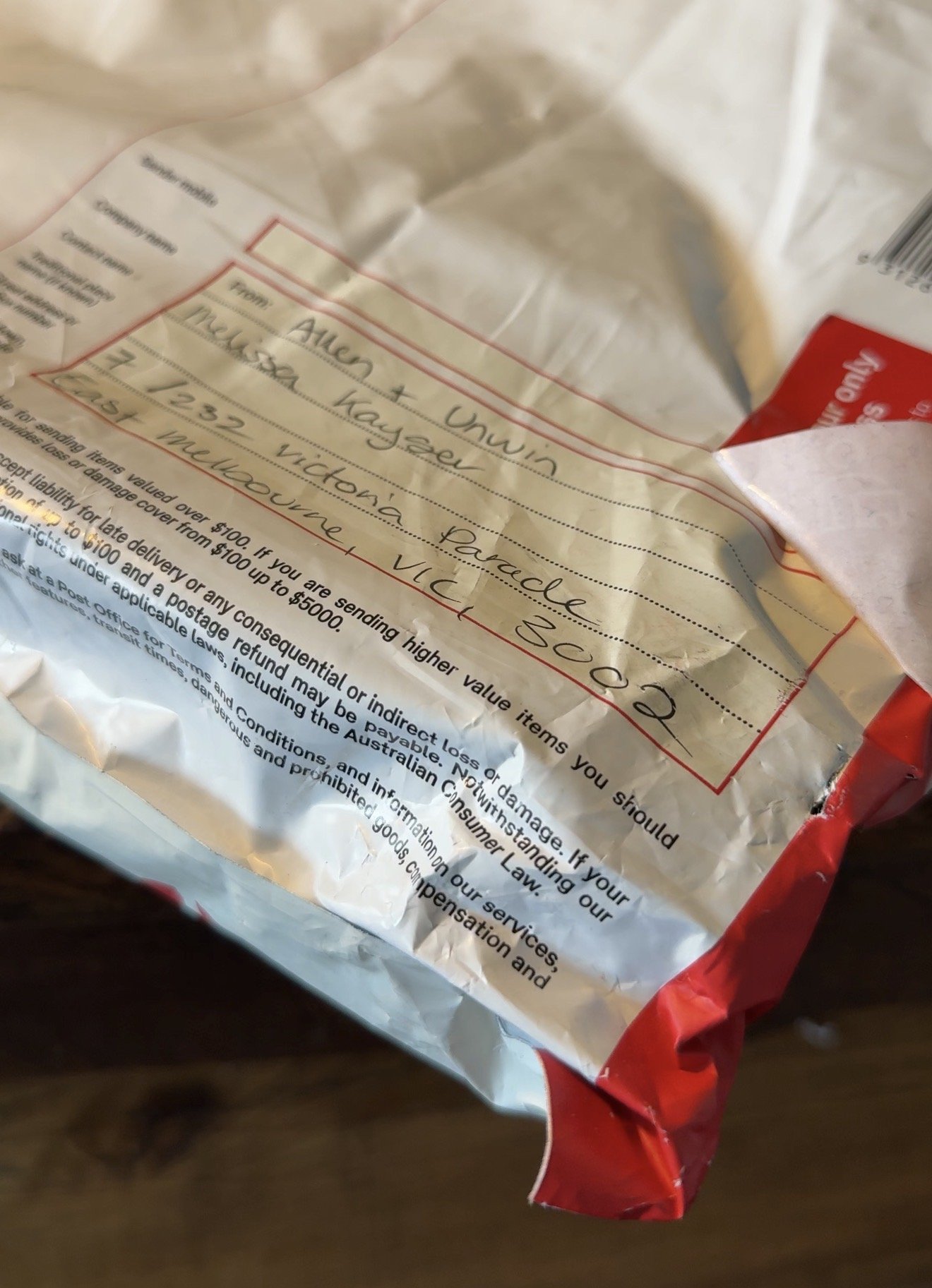
Even in it’s plastic mail pouch, and its bubble wrap shroud I can feel its dimensions. Even after all this time, it's thicker than I imagined. You grab it by its spine and it only just fits in my hand — it literally fills my entire hand. It's a hardback. It's heavy. Not so heavy you can't pick it up in one hand, but it's got resistance. It's got weight. Nearly a kilo. Eight hundred grams, something like that. I wouldn't want to be holding it for too long!
And on the back of the parcel, on the sender panel, is Melissa Keyser's handwriting. My publisher, at Murdoch Books. I've met Melissa in the flesh once, after so many meetings, and yet here is her actual handwriting, and it feels like the parcel has come directly from her hand to mine. There's something so visceral about that. It reminds me of having a penpal as a kid. Or a really close friend who moved interstate when I was a teen, and for years we'd send each other parcels and letters and casette tapes, and there is something about a person's name, handwritten, that is so deeply personal. It came straight from her. I can feel that too.
And maybe that's part of why I can't open it. Because a handwritten name carries a whole person — and this parcel carries a whole life. The writing of the book took a year. One year. And I think that's the thing people won't understand. Because the year is the smallest part of it. The rest of my life is on the pages.
I have been a gardener since I was a little girl. The garden is probably the closest thing to me — and I know how strange this sounds — in many ways the garden is closer to me than any human other than my own children. It's such a weird way to say it. But I've had a relationship with gardens my entire life that was more personal than anything else, because the garden was my safe space. It was where I could be myself. Where I didn't have to perform. Where I wasn't judged, where I didn't have to be perfect, where my validation came simply from being in the moment.
I'll tell you exactly what I mean, because then maybe you’ll fully understand. Years ago we went on a city staycation in Melbourne — one of those things everyone's supposed to love. Leave your town, live your city like a tourist, do all the things. We were in a high-rise, and it should have been wonderful, and instead I felt like a caged animal. The windows didn't open. I’m pretty sure the entire building had breathed the air being spewed from the air conditioner before me. I wasn't surrounded by anything green. I couldn't do my lap. I couldn't witness the day change. Outside, walking, I was fine — but the idea that this was where you were meant to relax, to stay, to sleep in and enjoy — I could not wait to get out. I needed to get home, to the countryside, to my garden, to my plants. That's what the garden is to me. Take it away and I feel out of my body.
And none of this was the life I was offered. My mum came here from former Yugoslavia, a displaced person, a refugee, from object poverty and suffering, and she wanted me to have an extraordinary education and a worthy profession — something that meant I'd always be okay. That mattered to her, and it came from everything she'd lived. To her, gardening was a hobby. So for me to be living the life I live now, doing what I'm doing — it's taken me ten years, longer, a whole lifetime of unravelling in fact. And this book holds all of it. Even the part I've never quite known how to hold.
The garden is also where I have done all my healing.
When my stepsister Leanne was killed on September 11, I was in my twenties, watching television with my boyfriend at the time, and a banner rolled across the bottom of the screen — World Trade Center: BREAKING NEWS — and we turned the channel. And I watched, at that very moment, the building she was working in being struck by a plane. It took me a few seconds to connect it. To realise. Isn't that the building Leanne's in?
The garden was the place I could grieve. Where I could move through some of the most uncomfortable feelings I've ever had. My hands in the soil, growing things, turning dirt into garden into produce into meals — and somehow, doing that, the world felt like maybe it was okay. There was something I could do. Somewhere I could be. Something I could tend and grow and shape toward an outcome, even when I had no control at all. A garden meets me wherever I am. It lets me be the best version of myself, even when I'm the worst version. It asks nothing of me and gives everything.
So when I tell you a gardening book holds my entire self, this is what I mean. This is why I can't just tear the wrapper off.
Here's the other thing — and this is the part that explains why the book is the shape it is, why it exists at all.
I have an entire library of horticultural books. Incredible ones, full of knowledge — organic gardening, composting, roses, all of it. I'm one of those people who takes nonfiction on holiday and reads it cover to cover AND absolutely loves it. But I'll be honest about those books: they inform me. They don't transport me. They don't take me somewhere I couldn't have imagined.
And then there are design books — beautiful books, full of imagery of projects and spaces. Those ones transport me. I don't just look at the images, I reimagine them. There's a whole bodily connection to it — I look and I think, imagine if I did that bit of that project in my own garden, imagine that textural combination translated into my own space. They're transformational. But here's the catch: if all you have is a balcony and a few pots and no idea how to even grow a seed, you can't begin from inside a book like that.
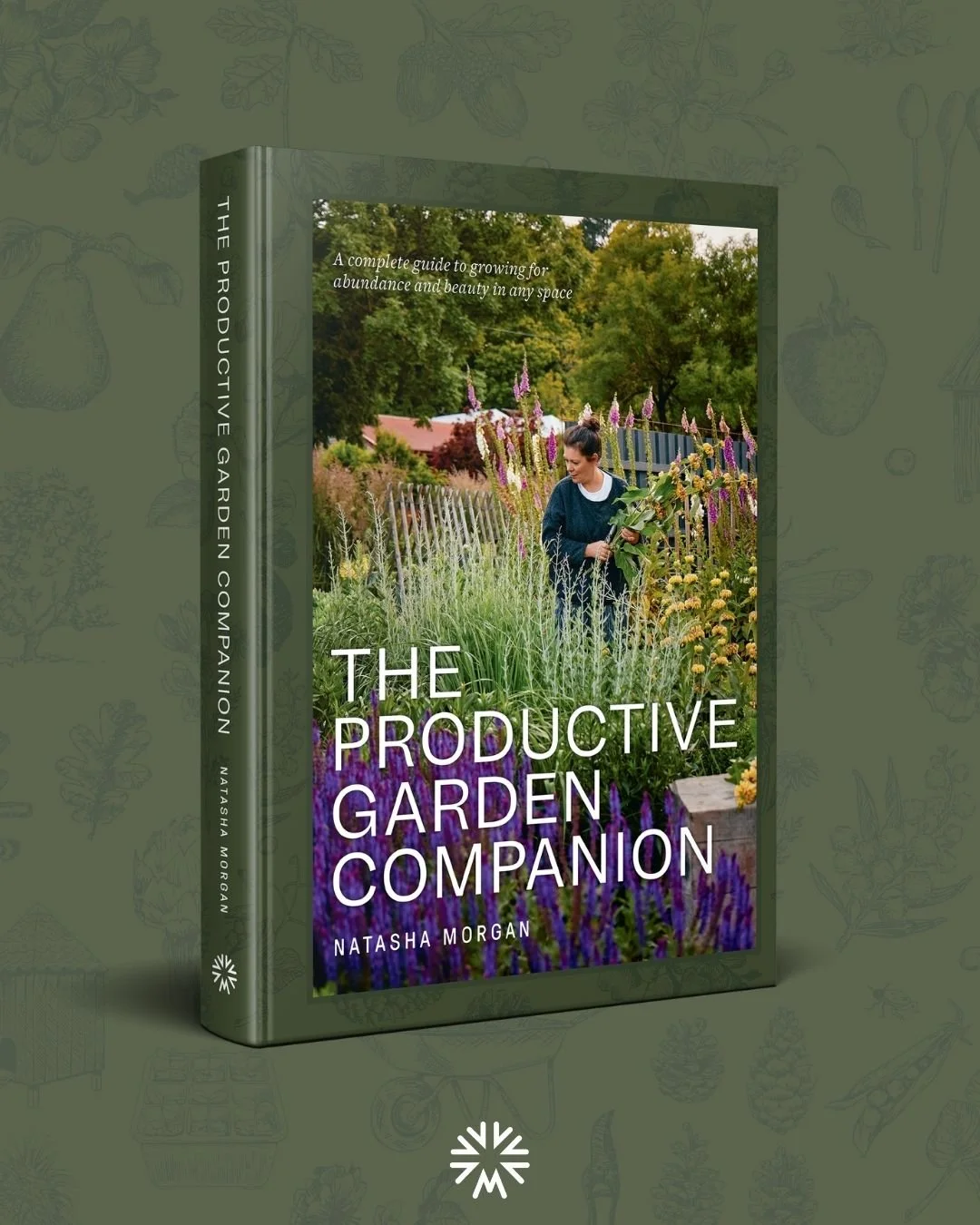
So I wanted to write the book I couldn't find. One that does both. That transports you and gives you somewhere to start. And it turns out I had so much to give that we literally ran out of pages — the book is now around 135,000 words, down from 150,000, not because I had nothing more to say but because not one more page could be squeezed in. It is full to its very edges. On purpose. That's not a flaw in the production. That's me.
Because I wanted this book to be generous, and I wanted it to be invitational. Companion is not an accident. A companion, to me, isn't a noun — it's a doing word. A verb. Something that walks alongside you. And I wanted this book to have a life beyond its pages, which is why there are QR codes threaded through it that take you to recorded conversations — real conversations, with people I was so nervous to ask, certain they'd say no, and they didn't. Twenty-four contributors from around the world, woven in. Their stories, their expertise, their lived experience, sitting right alongside mine.
And yet despite all those pages and words, I wrote it for one person. A single reader. As I wrote, I genuinely thought about you — whether you're the woman wondering how to build a life worth living inside a relationship that feels impossible; whether you've only got a balcony and a few pots and don't know where to start; whether you've designed your whole life and want to finally put your hands in the soil; or you've had your hands in the soil forever and want to bring design to it. I thought of every one of you. And I wanted to give you permission to begin exactly where you are, with whatever you have, and to offer to walk beside you, every step of the way.
One of the people walking through these pages is Dr Lee Ariav — one of my university lecturers, twenty-odd years ago, who told me you know more than you think you know; you have all the answers. It has taken me a whole lifetime, fifty years, to be able to acknowledge that for myself. He writes the closing reflection of the book. Which is a crazy, weird thing to be saying about a gardening book — that it has a narrative arc from one end to the other, that it feels like a coming home. But it does. This book sitting on my table, held tightly within an indestructible plastic sleeve, wads of bubble wrap — is a return, to me.
And I wasn't the only one who left their hands on it. Saffron — my daughter — is fifteen, and she did the illustrations. Close to fifty of them, the entire suite, in four days. Four days! She's extraordinary (and she left it right to the very last and stressful minute), and she seriously couldn’t care less. Oh yeah, whatever. It's a book. She doesn't seem to register the significance of being a published illustrator at fifteen, and maybe that is the point — maybe it's just a book, so what. But within it is something so fundamentally mine, and now hers.
She and her brother will be the first to see it. Before anyone watches that mandatory video of me unwrapping it, before it goes anywhere near the world, my kids will see it. That feels utterly huge too.
And maybe it's right that they see it before I do anything as grand as call myself an ‘author’ — because the truth is, I don't feel in the least like one. Yes, I've written a book, but it's not actually in the world yet. Yes, people can pre-order it. But, there are no physical copies anyone can pull off a shelf. So I don't feel like an author — I feel like someone who wrote a book. And honestly? I barely read books. Most of what I read is non-fiction, for f*ck's sake. I have no literary expertise. I don't inhabit a literary world.
It reminds me of my first-year students, when I used to teach landscape architecture. Some of them came straight out of high school with no idea what "good" was supposed to look like, no idea how to conform — and they were always my favourites. Because they just brought themselves. Their work was fresh and unique precisely because they weren't trying to be anything. And somebody once told me to write like no one's listening, and f*ck it — why not? You get to live once. When something is at the core of your being and it has given you everything, you stop worrying what people will think and you just do it anyway.
So maybe that's what I'm actually terrified of. Opening this package means it's about to land in someone else's life. And I won't be able to control what they make of it. Maybe they won’t know what to make of me.
I thought about opening it at my every morning ritual, Cliffy's — because the staff and that whole community held me the entire time I was writing, day after day, and they probably seriously deserve to be there. I thought about gathering a few mates around the table. But none of it feels right.
And I think I know why, because I've done this before. When I launched my business — Natasha Morgan, my own name, because it was me, and bearing my name made it the only thing that couldn’t be taken away from me — I showed no one. Not even my partner at the time. I didn't want anyone asking why that font, have you thought about a different colour, what about a different structure. I wanted it to be wholly, totally, 110% true and mine before it met another single soul. That's how I do everything. Whatever I put into the world has to meet me in the fullest, most aligned way first — before it meets anyone else, before I invite anyone in. It's why I never showed this book to a soul but the publishers, and they only saw it once it was ‘finished’. They didn't change a single thing. They didn't restructure it. We trimmed it because I was over length, but they didn't touch what it was. And that’s something I’ll always be incredibly grateful for.
So… I this I owe it to myself to open this one alone. On my own terms. In the moment, with no one watching me find out.
And yet, I want to do the reveal with you. Not at you — with you. The person reading this, who's followed my journey for years, or who might have met me yesterday. Because the book is, fundamentally, for everyone who holds it.
And I want to share it because — well, this is the only thing I really believe. My son asked me once, when he was about five, what even is the purpose of life? And I said, life is for living — that's the purpose. And he looked at me and said, does it get any better? And I laughed, because, well, he was five, and… does it get better? It gets better and worse, all the time. Up and down, round and round. And you do it anyway. That's the whole point. This book is the embodiment of that — me, living, while I could, the only way I truly know how.
It's not a how-to, and yet it's full of knowledge. It's not a memoir, and yet it's full of my story. It's not a reference book, and yet I think you'll return to it over and over. It belongs as much on a bedside table as it does on a potting shed bench.
It's still sitting there right now, wrapped, on the kitchen table. I'm pretty sure I'm going to cry when I open it. I’m okay with that. I'm also okay with sitting in the discomfort for a day or two, until someone says for f*ck's sake, Tash, open it. But before I do — before I see it, before I flick its pages, before I smell the scent of the paper and feel the cover I agonised over for hours, days and weeks in bookshops — I want to give you the dedication. Because I dedicated this book before I'd even opened it. It's not to my mother, or my father, or my children (although there’s some special words within the pages for them too).
It's to you.
To you, beginning from exactly where you are: with a single pot on a sill, a small patch already full, or only an idea you haven't quite named yet.
To you, arriving with whatever you carry: experience or uncertainty, weariness or wonder, a lifetime in gardens or none at all.
These pages are my way of walking beside you, offering what I've learned and loved, in the hope that they keep you in good company as you grow your own way.
Stay connected for more seasonal inspiration:
Instagram | Facebook | Gardenstead | LinkedIn | Pinterest | YouTube | Website | Newsletter
Thanks so much for following along.
Natasha xx